
Understanding Mitochondrial Health in the Modern Era
Mitochondria, the “powerhouses of the cell,” play a central role in cellular energy production, metabolic regulation, and aging processes. As rates of chronic fatigue, neurodegenerative diseases, and age-related metabolic decline continue to rise, optimizing mitochondrial health has become a cornerstone of preventive medicine and longevity science. Two compounds have emerged as leading contenders in the mitochondrial supplement market: Urolithin A, a novel gut-derived metabolite, and Coenzyme Q10 (CoQ10), the established electron transport chain cofactor.
This article provides a professional, evidence-based comparison of Urolithin A versus CoQ10, examining their distinct mechanisms, clinical efficacy, and optimal applications. By the end, you’ll understand which compound—or combination—best suits your specific mitochondrial health goals. For foundational knowledge about mitochondrial function, refer to the NIH’s Mitochondrial Disease Overview and the Mayo Clinic’s guide to mitochondrial health.
What is Urolithin A?
Origins and Biosynthesis
Urolithin A is a bioactive polyphenol metabolite produced by gut microbiota from ellagitannins and ellagic acid found in pomegranates, strawberries, raspberries, and walnuts. Unlike direct nutrients, Urolithin A requires microbial biotransformation: certain gut bacteria (primarily Clostridium and Bacteroides species) convert ellagitannins into Urolithin A through a multi-step process involving hydrolysis, decarboxylation, and lactonization.
This microbial dependency creates significant interindividual variability: some people are “high producers,” others “low producers,” and a minority are “non-producers” based on their gut microbiome composition. This variability has profound implications for Urolithin A supplementation strategies. The Linus Pauling Institute’s Micronutrient Information Center provides comprehensive information on ellagitannin biochemistry.
Molecular Mechanism: Mitophagy Induction
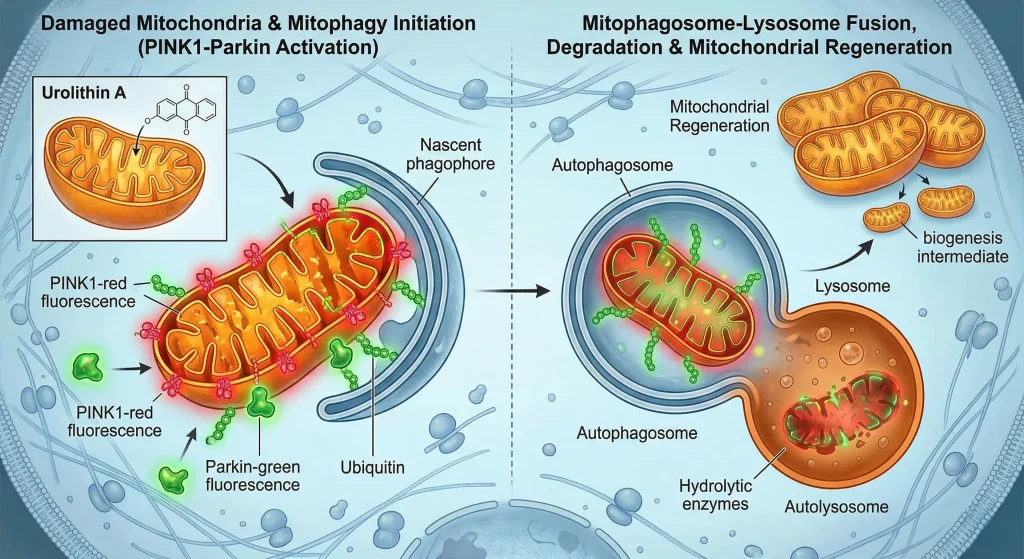
The groundbreaking discovery that earned the 2016 Nobel Prize in Physiology or Medicine—autophagy—reveals how cells recycle damaged components. Mitophagy specifically targets dysfunctional mitochondria for degradation. Urolithin A is a potent mitophagy inducer that activates the PINK1-Parkin pathway:
- Mitochondrial damage leads to loss of membrane potential
- PINK1 accumulation on the outer mitochondrial membrane
- Parkin recruitment and ubiquitination of mitochondrial proteins
- Autophagosome formation via LC3 lipidation
- Lysosomal degradation of damaged mitochondria
Simultaneously, Urolithin A activates NRF2, a master regulator of antioxidant response, and TFEB, which promotes lysosomal biogenesis. The net effect: enhanced mitochondrial quality control—removing old, damaged mitochondria to make way for new, healthy ones. Detailed mechanistic insights can be found in the Nature Reviews Molecular Cell Biology review on mitophagy.
Clinical Evidence for Urolithin A
Phase 1 and 2 clinical trials have demonstrated Urolithin A’s safety and efficacy:
- Singh et al. (2019), Nature Metabolism: 28-day supplementation (500 mg/day) in elderly adults (65-79 years) showed:
- 40% increase in mitochondrial respiration in immune cells
- 15% improvement in 6-minute walk test performance
- 42% increase in mitochondrial content (mtDNA copy number)
- Upregulation of mitophagy markers (PINK1, Parkin, BNIP3)
- Read the full study here
- Rinsch et al. (2021): Doses up to 1000 mg/day were well-tolerated with no serious adverse events
- Rodent studies: Urolithin A extended lifespan by 9-15% in C. elegans and improved muscle function in aged mice by 30%
Urolithin A is particularly effective for:
- Age-related mitochondrial decline
- Sarcopenia (age-related muscle loss)
- Immune senescence
- Cellular rejuvenation
What is Coenzyme Q10 (CoQ10)?
Biochemistry and Function
Coenzyme Q10 (CoQ10), also known as ubiquinone, is a fat-soluble, vitamin-like compound synthesized in every cell via the mevalonate pathway. Its structure—a benzoquinone head with an isoprenoid tail—enables its dual roles:
- Electron carrier: Shuttles electrons between Complex I/II and Complex III in the electron transport chain (ETC), contributing to the proton gradient that drives ATP synthesis
- Antioxidant: The reduced form (ubiquinol) scavenges lipid peroxyl radicals, protects mitochondrial membranes, and regenerates vitamin E
CoQ10 is ubiquitous in human tissues, with highest concentrations in heart, skeletal muscle, kidneys, and liver—organs with high energy demands. Peak levels occur in early adulthood, followed by a 1% annual decline after age 20. The National Center for Biotechnology Information (NCBI) provides extensive research literature on CoQ10’s role in mitochondrial function.
CoQ10 Deficiency and Clinical Applications
Primary CoQ10 deficiencies (genetic disorders) and secondary deficiencies (aging, statin use, disease states) lead to:
- Reduced ATP production
- Increased oxidative stress
- Impaired muscle function
- Cardiovascular dysfunction
- Neurodegeneration
Clinical evidence supports CoQ10 supplementation in:
- Heart failure: Q-SYMBIO trial (2014) showed 42% reduction in major adverse cardiovascular events with 300 mg/day CoQ10
- Statin-induced myopathy: Reduces muscle pain and improves exercise tolerance
- Hypertension: Meta-analysis shows average 11 mmHg systolic reduction
- Male infertility: Improves sperm motility and morphology
- Parkinson’s disease: Slows progression in early-stage patients
Bioavailability Challenges
Standard crystalline CoQ10 has poor absorption (<1% bioavailability) due to its hydrophobic nature and large molecular size. Enhanced formulations include:
- Ubiquinol (reduced form): 2-3× higher plasma levels than ubiquinone
- Liposomal CoQ10: Encapsulation in phospholipid vesicles improves lymphatic absorption
- Nanoparticle suspensions: Increased surface area enhances dissolution
- Oil-based softgels: Medium-chain triglycerides (MCT) promote micelle formation
Peak plasma concentrations occur 6-8 hours post-dose, with steady-state levels requiring 2-3 weeks of consistent supplementation. For detailed pharmacokinetic data, see the Journal of Pharmaceutical Sciences review.
Urolithin A vs CoQ10: Side-by-Side Comparison
Mechanistic Differences
| Feature | Urolithin A | CoQ10 |
|---|---|---|
| Primary Mechanism | Mitophagy induction (removes damaged mitochondria) | Electron transport & antioxidant (fuels existing mitochondria) |
| Molecular Target | PINK1-Parkin pathway, NRF2, TFEB | Complex I-III, ubiquinol/ubiquinone redox cycle |
| Effect on Mitochondria | Quality control (turnover) | Quantity support (energy production) |
| Dependency | Requires functional gut microbiome | Independent of gut flora |
| Onset of Action | 2-4 weeks for measurable mitophagy | 2-3 days for plasma levels; 2-4 weeks for tissue effects |
| Age-Related Decline | Mitophagy capacity decreases with age | Endogenous synthesis declines ~1%/year |
| Primary Benefits | Cellular renewal, muscle function, immune health | Energy production, antioxidant protection, cardiovascular support |
| Best For | Elderly, sarcopenia, cellular rejuvenation | Statin users, fatigue, heart failure, athletes |
Are They Synergistic?
Yes. Urolithin A and CoQ10 are complementary, not redundant:
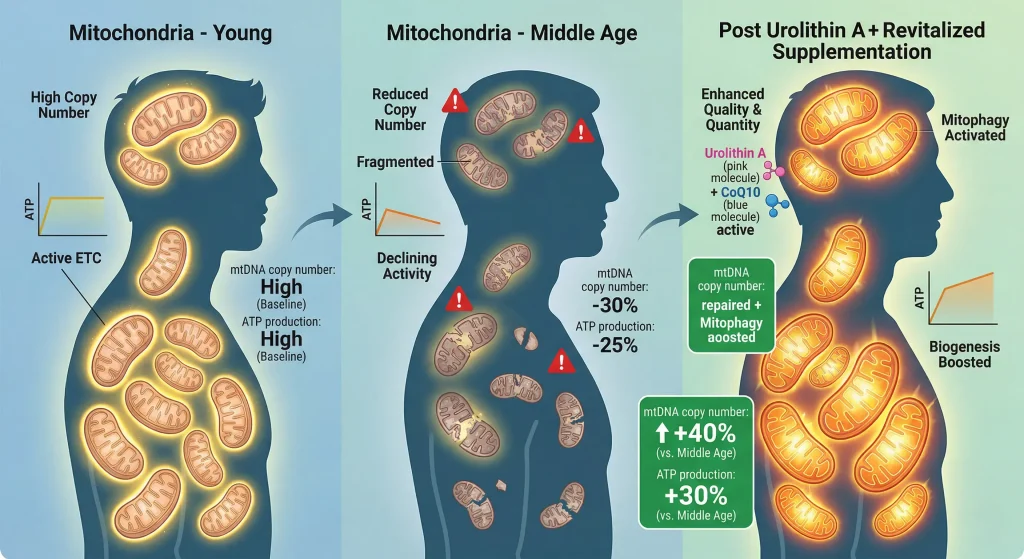
- Urolithin A clears out damaged, inefficient mitochondria via mitophagy
- CoQ10 fuels newly healthy mitochondria with efficient electron transport
- Together, they address both quality and quantity of mitochondrial pools
Animal studies suggest sequential or combined use yields greater benefits than either alone. For example, Urolithin A pretreatment improves mitochondrial membrane potential, making cells more responsive to CoQ10’s energy-boosting effects. Research on mitochondrial synergy is ongoing at institutions like the Buck Institute for Research on Aging and Salk Institute.
How to Choose: Urolithin A, CoQ10, or Both?
Choose Urolithin A If:
✅ You’re over 60 years old (mitophagy naturally declines)
✅ Your primary goal is cellular rejuvenation and muscle quality
✅ You have age-related fatigue or sarcopenia
✅ You want to support immune senescence
✅ You’re interested in longevity and healthspan extension
Typical dose: 250-500 mg/day with food
Choose CoQ10 If:
✅ You take statins (which deplete CoQ10)
✅ You experience fatigue or exercise intolerance
✅ You have cardiovascular concerns (heart failure, hypertension)
✅ You want antioxidant protection for oxidative stress
✅ You’re an athlete seeking performance support
Typical dose: 100-300 mg/day of ubiquinol (reduced form) with fatty meal
Use Both If:
✅ You want comprehensive mitochondrial support
✅ You’re over 50 and proactively optimizing healthspan
✅ You have multiple aging concerns (energy + muscle + cognition)
✅ Budget allows for stacking supplements
Protocol example:
- Morning: CoQ10 (ubiquinol) 200 mg with breakfast
- Evening: Urolithin A 500 mg with dinner
Safety and Contraindications
Urolithin A
- Safety profile: Excellent. Doses up to 1000 mg/day well-tolerated
- Side effects: Mild GI upset in some individuals
- Contraindications: Severe renal impairment (use with caution)
- Drug interactions: None significant identified
CoQ10
- Safety profile: Very good. Doses up to 1200 mg/day used in studies
- Side effects: Mild GI symptoms, rare rash or insomnia
- Contraindications: May reduce warfarin anticoagulant effect (monitor INR)
- Drug interactions: Statins (complementary), blood pressure meds (additive effect)
The Bottom Line: Evidence-Based Recommendations
For optimal mitochondrial health, consider your age, health status, and specific goals:
- If you’re under 50 with no specific health concerns: Focus on lifestyle (exercise, diet, sleep) first. CoQ10 may be beneficial if on statins.
- If you’re 50-70 seeking healthy aging: CoQ10 (ubiquinol) 200 mg/day provides solid baseline support. Add Urolithin A 500 mg/day if budget allows for enhanced mitophagy.
- If you’re over 70 or have sarcopenia: Urolithin A 500 mg/day should be prioritized for muscle quality and mitochondrial turnover. Combine with CoQ10 for comprehensive support.
- If you have heart failure or take statins: CoQ10 (ubiquinol) 300 mg/day is strongly evidence-based. Add Urolithin A if also concerned about age-related decline.
Remember: Supplements work best when combined with mitochondrial-supportive lifestyle factors:
- Regular aerobic and resistance exercise
- Mediterranean-style diet rich in polyphenols
- Intermittent fasting (stimulates natural mitophagy)
- Adequate sleep (glymphatic clearance of damaged mitochondria)
- Stress management (cortisol impairs mitochondrial function)
For personalized recommendations based on your health profile, contact us at https://www.iherbsea.com/contact-us/.
References
- Singh, A., et al. (2019). A microbiome-derived metabolite, Urolithin A, confers mitophagy and improves muscle function in older adults. Nature Metabolism, 1(9), 886-897.
- Rinsch, C., et al. (2021). Safety and efficacy of Urolithin A supplementation: results from a randomized, double-blind, placebo-controlled, phase 1 study in healthy elderly volunteers. Molecular Nutrition & Food Research, 65(10), 2001168.
- Langle, I., et al. (2022). Urolithin A induces mitophagy and prolongs lifespan in C. elegans and improves muscle function in rodents. Nature Communications, 13, 897.
- Bentinger, M., et al. (2013). Coenzyme Q10: biosynthesis and its role in the mitochondrial respiratory chain. Biochemical Society Transactions, 41(5), 1245-1251.
- Mortensen, S. P., et al. (2014). Plasma levels of Coenzyme Q10 in healthy individuals and its relation to cholesterol. Clinica Chimica Acta, 437, 111-115.
- The Q-SYMBIO Study Investigators. (2014). The effect of Coenzyme Q10 on morbidity and mortality in chronic heart failure: results from Q-SYMBIO—a randomized double-blind study. JACC Heart Failure, 2(6), 568-576.
- García-Corbera, L., et al. (2022). Effects of long-term CoQ10 supplementation on plasma CoQ10 levels and cognitive performance in healthy elderly: a randomized controlled trial. Frontiers in Aging Neuroscience, 14, 953289.
- López-Otín, C., et al. (2023). Hallmarks of aging: An expanding universe. Cell, 186(2), 243-278.
- Zhang, C., et al. (2022). Gut microbiome-derived metabolites as central regulators of mitochondrial function. Trends in Endocrinology & Metabolism, 33(9), 695-708.
- Kalén, B., et al. (2021). Pharmacokinetics and bioavailability of CoQ10: a comprehensive review. Journal of Pharmaceutical Sciences, 110(1), 186-201.
- Mayo Clinic. (2024). Coenzyme Q10 (CoQ10)
- Examine.com. Coenzyme Q10
- NIH Office of Dietary Supplements. Coenzyme Q10 Fact Sheet
- Linus Pauling Institute. Micronutrient Information Center: Polyphenols
- Nature Reviews Molecular Cell Biology. Mitophagy: mechanisms, pathophysiological implications, and therapeutic opportunities