
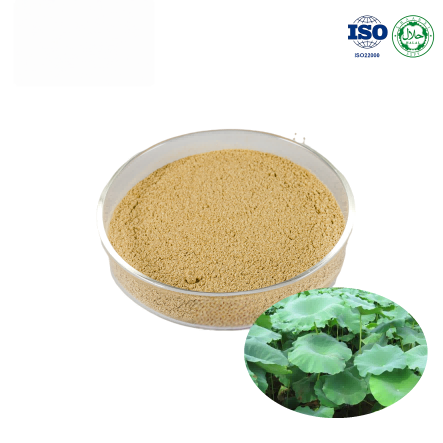
Introduction Of Lotus Leaf Extarct
The lotus leaf is the leaf of lotus Nelumbo nucifera Gaertn of the Water Lily family.
The leaves are mostly folded into semicircular or fan-shaped, unfolded and shield-like, 20~50cm in diameter, entire or slightly undulate. The upper surface is dark green or yellowish green, rough; the lower surface is light grayish brown, smooth, with 21~22 thick veins, shooting out from the center to the surrounding area, and there is a protruding petiole residue in the center. The texture is brittle, easy to break. Slightly clear aroma, taste slightly bitter.
Function Of Lotus Leaf Extarct
1, Lotus leaf is widely used in obesity and hyperlipidemia, lotus leaf flavonoids lower serum cholesterol (TC), lower serum triglycerides (TG), reduce body weight and elevate serum HDL-C, HL and LPL enzyme activity of the role of the body’s digestive capacity, reduce the absorption of lipids and carbohydrates and enhance the regulation of lipid metabolism and energy loss, so as to effectively counteract obesity.
2, Lotus leaf extract has antioxidant effect, elevate SOD, GSH-Px, reduce MDA, have good DPPH free radical scavenging ability, and can effectively inhibit the oxidation of linoleic acid, and in the concentration of lower can reach half scavenging.
3, Lotus leaf extract on Penicillium, yeast, Aspergillus niger and red yeast have some inhibitory effect, but the inhibitory effect on yeast and red yeast is better than the inhibitory effect on Penicillium and Aspergillus niger, and with the increase of the concentration of the extract, the inhibitory effect is enhanced”, and it has an inhibitory effect on bacteria, molds and yeasts.
4, Lotus leaf extract has no selective inhibition of nerve excitation caused by amino acids and has inhibitory effect on nerve excitation caused by glutamic acid.


