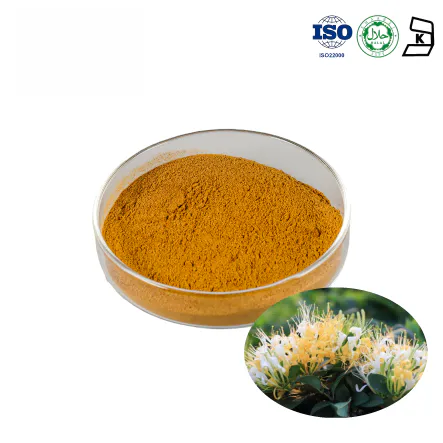
Product Overview: Lonicera Japonica Extract
Lonicera Japonica Extract is a natural plant extract derived from the classic Chinese medicinal herb honeysuckle (Lonicera japonica). Its core active ingredient is chlorogenic acid, and the product presents as a brown powder. Due to its excellent biological activity and safety, it is widely used as a raw material in pharmaceuticals, health products, and cosmetics industries.
The raw material of our Lonicera Japonica Extract is the dried flower buds or newly opened flowers of Lonicera japonica (family Caprifoliaceae). The raw medicinal material has distinct characteristics: it is rod-shaped, thick at the base and slightly curved, 2-3cm in length, with an upper diameter of 3mm and a lower diameter of 1.5mm; the surface is yellowish-white or greenish-white, covered with dense downy hairs. In addition to the core component chlorogenic acid, it also contains luteolin and other bioactive substances, which are fully retained through advanced extraction technology to ensure product efficacy.
Core Functions & Efficacy of Lonicera Japonica Extract
1. Lipid-Lowering Effect
Lonicera Japonica Extract can effectively regulate lipid metabolism: it reduces the levels of cholesterol and triglycerides in plasma, and lowers the triglyceride content in the liver. At the same time, it helps reduce the levels of vitamin E and cholesterol in tissues such as the lungs and liver, providing positive support for maintaining cardiovascular health.
2. Anti-Leukemia Activity
The extract has anti-leukemic activity, which can inhibit Ber-Abl and c-Abl tyrosine kinases. It can induce apoptosis in Ber-Abl-positive cells, including Ber-Abl-positive primitive lymphocytes in patients with chronic myeloid leukemia, making it a potential auxiliary raw material for anti-leukemia-related product development.
3. Immunomodulatory Effects
Lonicera Japonica Extract exerts a significant immunomodulatory effect: it prominently enhances T cell proliferation induced by influenza virus antigen, and induces the production of γ-IFN and α-IFN in human lymphocytes and peripheral blood leukocytes. Additionally, it can activate calcineurin and enhance macrophage function, comprehensively improving the body’s immune defense capability.
4. Hypoglycemic Effect
Preclinical studies have confirmed that Lonicera Japonica Extract has a hypoglycemic effect in animals. The possible mechanism is related to the inhibition of glucose-6-phosphate dehydrogenase activity and the regulation of glucose uptake, providing a natural and safe raw material option for the development of blood sugar-regulating health products.
Why Choose Our Lonicera Japonica Extract?
-
High-Quality Raw Materials: Selected from high-quality Lonicera japonica flower buds and newly opened flowers in pollution-free planting bases, ensuring high content of chlorogenic acid and other active ingredients.
-
Advanced Extraction Technology: Adopts modern precision extraction and purification processes, maximizing the retention of core bioactive substances while ensuring high product purity and stable efficacy.
-
Multi-Functional Advantages: Integrates lipid-lowering, immunomodulatory, hypoglycemic and anti-leukemia activities, covering multiple high-demand health fields with broad application prospects.
-
Wide Application Compatibility: Suitable for raw materials of pharmaceuticals, health products (lipid-lowering, immune-enhancing, blood sugar-regulating products) and cosmetics, meeting diverse production needs of B-end manufacturers.
-
Strict Quality Control: Implements full-process quality inspection from raw material selection to finished product delivery, with strict detection of active ingredient content and impurities, ensuring consistent quality and safety of each batch.
Application Scenarios
Widely applied in the formulation of lipid-lowering and cardiovascular health products, immune-enhancing nutritional supplements, blood sugar-regulating functional foods, pharmaceutical auxiliary materials, and cosmetics with antioxidant and anti-inflammatory effects. It fully meets the production needs of health product factories, pharmaceutical companies, cosmetic enterprises, and the health maintenance needs of individual consumers.
-
Process Of Lonicera Japonica Extract