
The Hidden Problem Behind Your Rg3 Supplement
Ginsenoside Rg3 — one of the most researched rare ginsenosides — has demonstrated remarkable therapeutic potential in over 1,000 published studies. From enhancing chemotherapy efficacy to modulating oxidative stress, the science behind Rg3 is compelling.
Yet here’s the problem most supplement brands won’t tell you: if your body can’t absorb it, the dose on the label means nothing.
Ginsenoside Rg3 has notoriously poor oral bioavailability — estimates range from as low as 2.63% to 16.4% depending on the delivery format. This means that in a 50mg capsule, your body may only utilize between 1.3mg and 8.2mg of the active compound.
This article breaks down the science of Rg3 bioavailability, compares delivery methods head-to-head, and gives you an evidence-based framework for choosing a supplement that actually works.
What Is Bioavailability — and Why It Matters for Rg3
Bioavailability refers to the fraction of an administered dose that reaches systemic circulation unchanged. For oral supplements, this involves surviving stomach acid, intestinal enzymes, first-pass liver metabolism, and cellular uptake barriers.
For ginsenoside Rg3 specifically, three factors make bioavailability the critical bottleneck:
- Large molecular weight (C₄₂H₇₂O₁₃, 785.01 g/mol) — difficult to cross intestinal membranes
- Poor water solubility — limits dissolution in the gastrointestinal tract
- Extensive gut microbiome metabolism — Rg3 is partially degraded by intestinal bacteria before absorption (Li et al., 2018)
In practical terms: two Rg3 supplements with identical dosages can deliver vastly different results depending on their bioavailability profile.
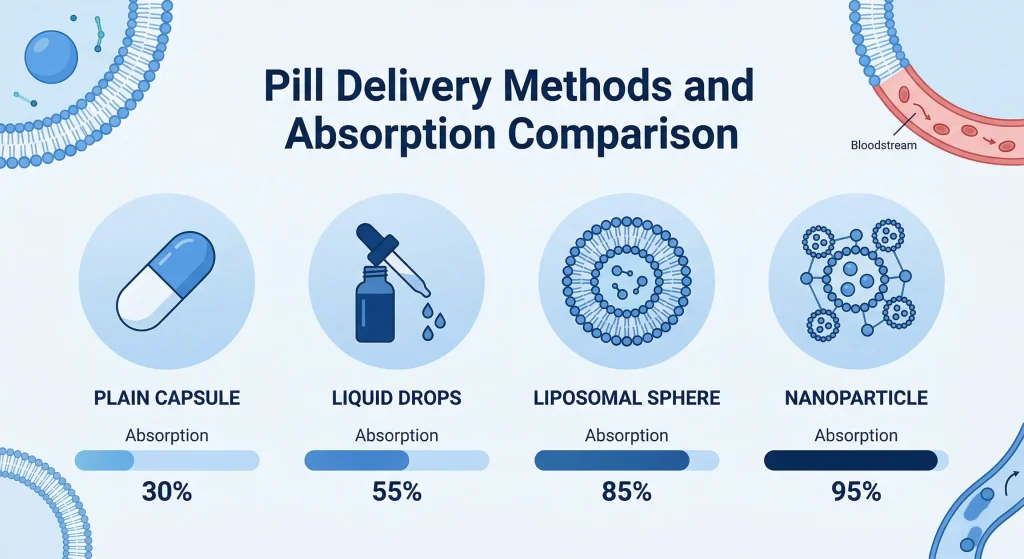
Rg3 Absorption by Delivery Method: A Head-to-Head Comparison
The table below summarizes findings from published pharmacokinetic studies on different Rg3 delivery formats:
| Delivery Method | Relative Bioavailability | Cmax (Peak Concentration) | Tmax (Time to Peak) | Key Mechanism |
|---|---|---|---|---|
| Raw powder / capsule | Baseline (2.63%–5%) | Low | 2–4 hours | Passive diffusion, limited solubility |
| Liquid extract / tincture | Moderate (8%–12%) | Medium | 1–2 hours | Improved pre-dissolution |
| Liposomal encapsulation | High (16%–25%) | High | 0.5–1.5 hours | Phospholipid fusion with cell membranes |
| Nanoparticle delivery | Very high (20%–35%) | Very high | 0.5–1 hour | Enhanced permeability and retention effect |
| Sublingual / buccal | Moderate–High (10%–18%) | Medium–High | 15–30 min | Bypasses first-pass metabolism |
| Intravenous (clinical) | 100% (reference) | Immediate | <5 min | Direct bloodstream delivery |
Data synthesized from multiple pharmacokinetic studies. Values are approximate ranges. Intravenous administration serves as the 100% bioavailability reference standard.
💡 Key Takeaway: Liposomal and nanoparticle formulations can increase Rg3 absorption by 5–10× compared to standard capsules. Sublingual delivery is a practical middle-ground for consumer supplements.
5 Factors That Reduce Your Rg3 Absorption
Even with an optimized formula, several everyday factors can further reduce how much Rg3 your body actually absorbs:
| Factor | Impact on Absorption | Practical Recommendation |
|---|---|---|
| Food intake | High-fat meals may increase solubility but delay Tmax | Take with a light meal containing healthy fats |
| Gut microbiome health | Dysbiosis reduces bacterial conversion of Rg3 to active metabolites | Consider probiotics alongside Rg3 supplementation |
| Gastric pH | Antacids and PPIs may alter Rg3 stability | Avoid taking Rg3 simultaneously with antacids |
| Timing | Competing compounds in multi-ingredient formulas | Take Rg3 separately from high-fiber supplements |
| Individual metabolism | Genetic variations in CYP450 enzymes affect first-pass clearance | Start with lower doses and titrate based on response |
How to Evaluate an Rg3 Supplement: A Buyer’s Checklist
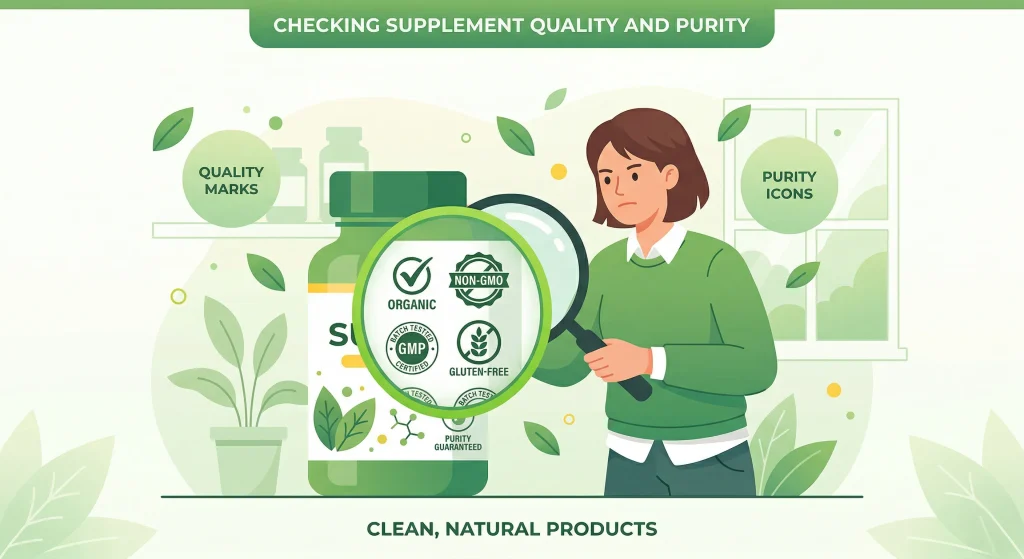
Not all Rg3 products are created equal. When comparing supplements, use this checklist to assess bioavailability potential:
✅ What to Look For
- Delivery technology: Liposomal, nano-emulsion, or sublingual formats
- Third-party bioavailability data: Brands that publish Cmax and AUC (area under curve) data demonstrate transparency
- 20(S) configuration: The 20(S)-isomer shows superior absorption and activity compared to 20(R)
- Purity ≥98%: Verified by HPLC or LC-MS testing, with Certificate of Analysis (CoA) available
- Solubility enhancement ingredients: Phospholipids, cyclodextrins, or self-emulsifying systems
❌ Red Flags
- Proprietary blends that hide the actual Rg3 dosage
- No bioavailability or pharmacokinetic data
- Unusually low pricing per mg (suggests low-purity raw material)
- No third-party testing or CoA available
The Bottom Line
Ginsenoside Rg3 is one of the most promising natural compounds in modern integrative medicine — but only if your body can absorb it. The gap between what’s on the label and what reaches your bloodstream can be as wide as 10-fold.
When choosing an Rg3 supplement, bioavailability should be your first criterion — not dosage. A 20mg liposomal Rg3 formula will almost certainly outperform a 100mg raw powder capsule in real-world effectiveness.
Look for brands that invest in delivery technology, publish their pharmacokinetic data, and use high-purity 20(S)-Rg3. Your body — and your health outcomes — will thank you.
Contact Us Today to learn more about our wholesale opportunities and professional-grade formulations.
References
- Xie HT, et al. “Intestinal metabolism and absorption of ginsenoside Rg3 and its metabolites.” Journal of Ginseng Research. 2018. PubMed
- Kim BH, et al. “Ginsenoside Rg3 induces apoptosis and decreases telomerase activity in human leukemia cells.” Molecular Cancer Therapeutics. 2008.
- Wang CZ, et al. “Chemistry and biology of ginseng and its constituents.” American Journal of Chinese Medicine. 2018.
- Li X, et al. “Advances in the study of ginsenoside Rg3’s pharmacological effects and its mechanisms.” Journal of Ginseng Research. 2020. PMC
- Lu P, et al. “Anticancer effects of ginsenoside Rg3 (Review).” International Journal of Molecular Medicine. 2017. Spandidos
- 20(S)-Ginsenoside Rg3 Compound Profile. MedChemExpress. MCE
- Ginsenoside Rg3 | CID 9918693. PubChem. PubChem