
Introduction: You May Be Taking the Wrong Supplement
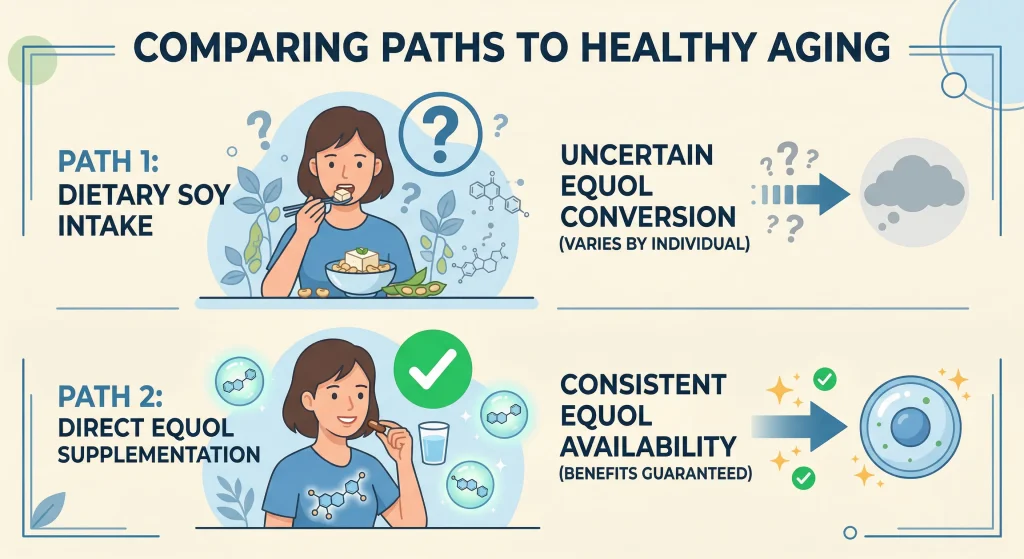
If you’ve tried soy isoflavone supplements for menopause relief and felt… nothing, you’re not alone. Studies consistently show that only 20–35% of Western women and 50–70% of Asian women can actually convert soy isoflavones into their most active form — a compound called equol (Setchell et al., 2007).
This means the majority of women taking standard soy isoflavone supplements are getting a fraction of the potential benefit. The problem isn’t the supplement — it’s your gut.
This article breaks down the critical differences between equol and soy isoflavone, explains the equol producer vs. non-producer phenomenon, and helps you make an informed decision for menopause symptom management.
What Are Soy Isoflavones?
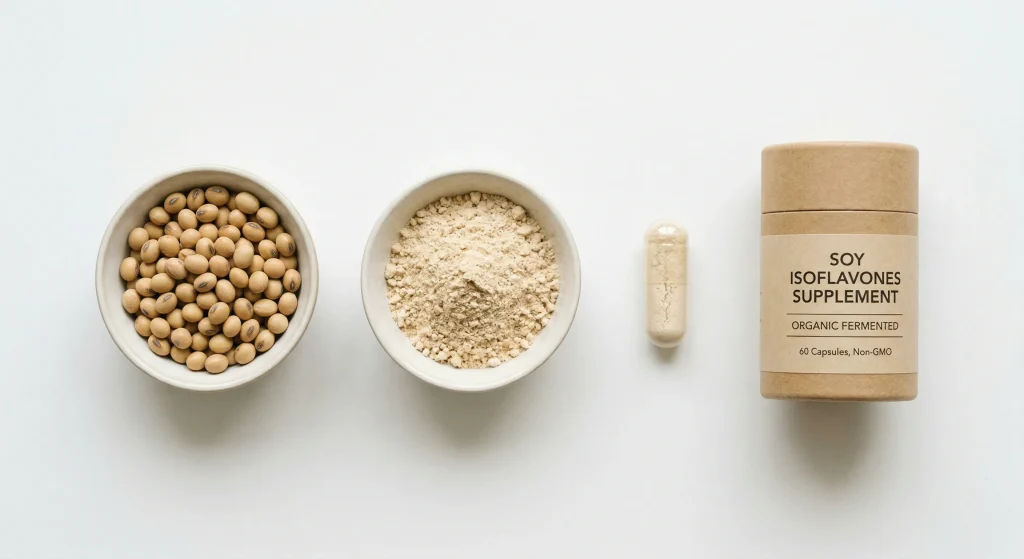
Soy isoflavones are naturally occurring plant compounds (phytoestrogens) found in soybeans. The two most important types are:
- Daidzein — the precursor that your gut bacteria convert into equol
- Genistein — another major isoflavone with independent biological activity
When you consume soy foods or standard isoflavone supplements, your body receives daidzein, not equol. The conversion to equol depends entirely on whether your gut microbiome contains the right bacteria (primarily Slackia isoflavoniconvertens and Adlercreutzia equolifaciens).
The catch? Most women don’t have these bacteria.
What Is Equol — and Why Is It Different?
Equol is not found in soy itself. It is a bacterial metabolite produced when specific gut bacteria digest daidzein. Despite being a metabolite, equol is far more biologically potent than its parent compound:
- Equol has a stronger binding affinity for estrogen receptor β (ERβ) than daidzein
- Equol is exclusively produced by gut bacteria — you cannot get it directly from food in meaningful amounts
- Equol has a longer half-life in the body, meaning more stable blood levels
In simple terms: equol is the “activated” form of soy isoflavone, and your body may or may not be able to produce it.
Head-to-Head Comparison: Equol vs Soy Isoflavone
| Parameter | Soy Isoflavone | Equol (Direct Supplementation) |
|---|---|---|
| Active compound | Daidzein + Genistein | S-Equol (already converted) |
| Depends on gut bacteria? | ✅ Yes — must be converted to equol | ❌ No — ready to use |
| Works for non-producers? | ⚠️ Limited efficacy (~70% of Western women) | ✅ Effective for everyone |
| Binding affinity to ERβ | Moderate | High (stronger than daidzein) |
| Half-life | ~4–8 hours (daidzein) | ~12–24 hours (equol) |
| Hot flash reduction | Mixed results; significant only in producers | Consistent reduction in clinical trials |
| Bone density support | Modest; inconsistent across studies | Clinically proven at 10mg/day for 12 months |
| Skin anti-aging | Limited evidence | 12-week clinical improvement in wrinkles |
| Available in supplement form | Very common | Rare — niche market |
The Equol Producer Problem: The Science You Need to Know
The “equol producer phenotype” is one of the most important — and most overlooked — concepts in menopause supplement science.
Key Facts
- Only 20–35% of Western adults can produce equol from daidzein (Setchell et al., 2007)
- 50–70% of Japanese adults are equol producers (likely due to lifelong soy-based diets)
- Producer status is not permanent — it can change with diet, antibiotics, and probiotics
- There is no reliable at-home test for equol producer status (urine testing after a soy challenge is the clinical standard)
Why This Matters
A landmark study published in Nutrients (2022) concluded:
“Maximizing the estrogenic potential of soy isoflavones depends critically on the individual’s equol-producing capacity. For non-producers, direct equol supplementation is the only reliable strategy.”
Translation: if you’re a non-producer, standard soy isoflavone supplements are essentially inactive.
Clinical Evidence: What Studies Show
Hot Flashes & Menopausal Symptoms
A 12-week clinical trial showed that 10–30mg/day of natural S-equol significantly reduced hot flash frequency compared to placebo, with the 30mg dose showing the strongest effect (NutraIngredients, 2012).
Importantly, soy isoflavone supplements only showed significant hot flash reduction in women confirmed to be equol producers — reinforcing that equol is the active agent, not daidzein itself.
Bone Health
A 12-month intervention study found that 10mg/day of S-equol prevented the decrease in whole-body bone mineral density in postmenopausal non-producer women (Tousen et al.).
Skin Health
Oral S-equol supplementation at 10mg and 30mg for 12 weeks significantly reduced wrinkle area and depth in postmenopausal women, with the 30mg dose showing superior results (PMC, 2021).
What to Look for in an Equol Supplement
If you’re convinced that direct equol supplementation is the better path, here’s what matters:
| Criteria | What to Check |
|---|---|
| Equol source | Fermented soybean germ powder — the most natural, bioavailable form |
| S-equol vs R-equol | S-equol is the biologically active enantiomer; always choose S-form |
| Equol content | 5% equol content is standard for fermented soy germ powder |
| Daily equol dose | 10–30mg S-equol per day (clinical dose range) |
| Third-party testing | HPLC-verified equol content with Certificate of Analysis |
| Clean label | No synthetic fillers, no unnecessary additives |
Conclusion: The Clear Winner for Most Women
The evidence is clear: equol is the superior choice for menopause management — not because soy isoflavones are ineffective, but because most women’s bodies can’t unlock their potential.
If you’re among the 65–80% of Western women who are equol non-producers, taking standard soy isoflavone supplements is like handing your body a locked box without the key. Direct equol supplementation — especially from fermented soybean germ powder — gives you the active compound directly, no gut conversion required.
For hot flashes, bone health, skin aging, and overall menopause symptom relief, equol isn’t just better — it’s the only choice that works for everyone.
References
- Setchell KDR, et al. “Microbial and Dietary Factors Are Associated with the Equol Producer Phenotype in Healthy Postmenopausal Women.” Journal of Nutrition. 2007. ScienceDirect
- Rimbach G, et al. “Maximizing the Estrogenic Potential of Soy Isoflavones.” Nutrients. 2022;14(3):553. MDPI
- Tousen Y, et al. “Natural S-equol decreases bone resorption in postmenopausal non-equol-producing women.” Menopause. 2011. Semantic Scholar
- Oyama N, et al. “Effects of an equol-containing supplement on advanced glycation end products and skin aging.” Molecules. 2021. PMC
- Jackson RL, et al. “Equol Improves Menopausal Symptoms in Japanese Women.” Journal of Medicinal Food. 2011. ResearchGate
- Equol: A Bacterial Metabolite from The Daidzein Isoflavone and Its Health Benefits. Advances in Nutrition. 2019. PMC
- S-equol supports PMS, menopause and healthy aging. NutraIngredients. 2025. NutraIngredients