
In the realm of functional medicine and longevity science, few molecules hold as much prestige as Nicotinamide Adenine Dinucleotide (NAD). Often referred to as the “molecule of life,” NAD exists in two primary states within the human body: NAD+ (the oxidized form) and NADH (the reduced form).
While both are essential for survival, the debate over which is superior for combating Chronic Fatigue Syndrome (CFS), fibromyalgia, and general lethargy has intensified. This guide provides a deep, evidence-based exploration into the biochemical differences between NADH vs NAD+, their roles in ATP production, and why the “Reduced Form” might be the missing link in your mitochondrial recovery protocol.
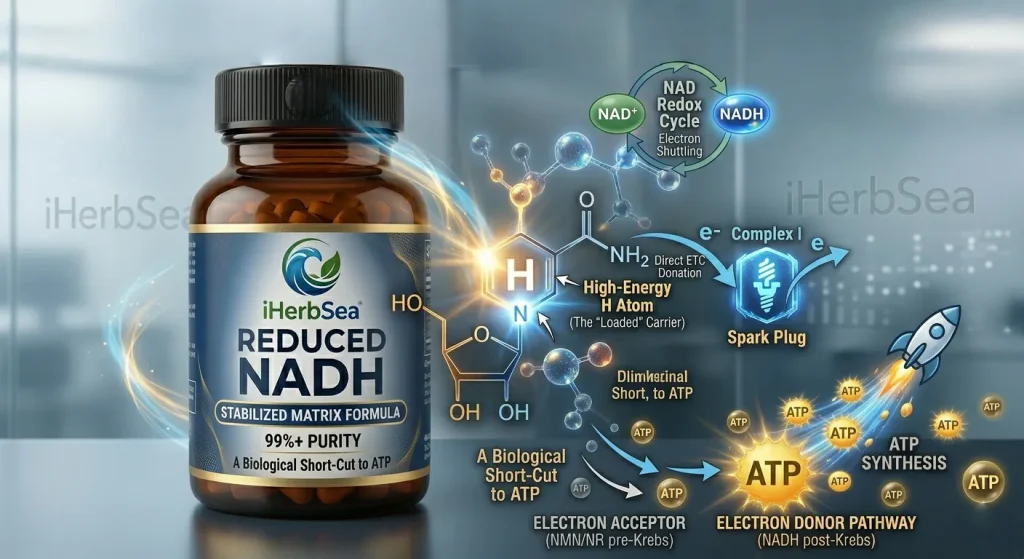
1. Understanding the NAD Redox Cycle: A Biochemical Primer
To understand why one might choose NADH over NAD+ for fatigue, we must first look at the Redox (Reduction-Oxidation) cycle. In every cell of your body, NAD acts as a coenzyme that shuttles electrons from one reaction to another.
The NAD+/NADH Ratio
The balance between these two forms—the NAD+/NADH ratio—is a critical marker of metabolic health. Research available on Nature Reviews Molecular Cell Biology suggests that this ratio dictates the pace of cellular aging and energy availability.
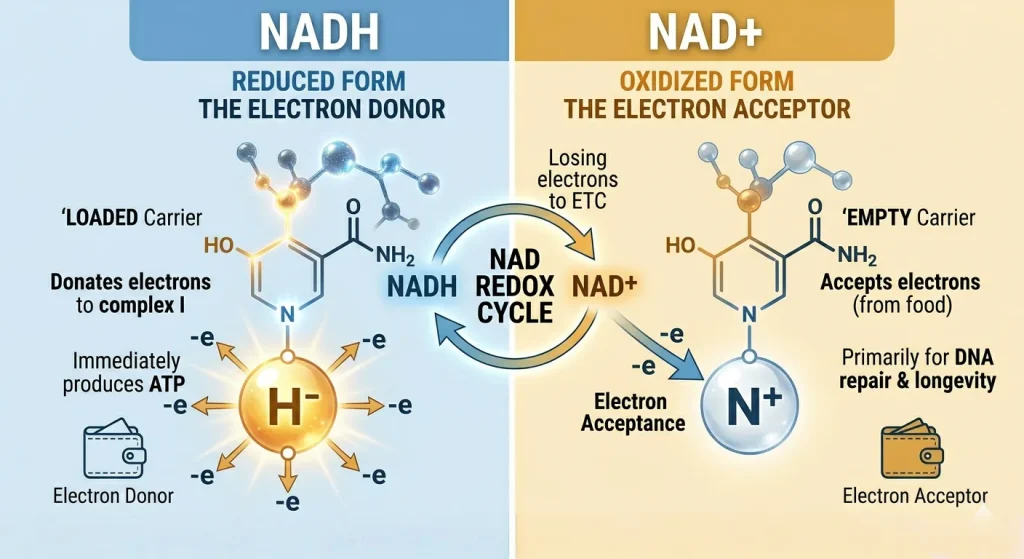
- NAD+ is the “empty” electron carrier. It accepts electrons from the food we eat (glucose and fats).
- NADH is the “loaded” carrier. It carries high-energy electrons directly into the Electron Transport Chain (ETC) in the mitochondria.
For individuals suffering from Chronic Fatigue, the issue is rarely a total lack of NAD; rather, it is often a breakdown in the efficiency of this cycle. When the mitochondria cannot effectively convert NADH back into NAD+, cellular respiration stalls, leading to a massive drop in Adenosine Triphosphate (ATP)—the body’s universal energy currency.
2. Chronic Fatigue Syndrome (CFS) and Mitochondrial Dysfunction
Chronic Fatigue Syndrome (ME/CFS) is no longer viewed merely as “being tired.” Modern research identifies it as a state of bioenergetic failure. According to data hosted by the National Center for Biotechnology Information (NCBI), mitochondrial dysfunction is a primary driver of the physical and cognitive exhaustion seen in CFS patients.
The Role of Oxidative Stress
Patients with CFS often exhibit high levels of oxidative stress and systemic inflammation. This environment damages the mitochondrial membranes, making it harder for NAD+ precursors (like NMN or NR) to be utilized effectively.
Why NADH is the “Action” Molecule
While NAD+ is famous for activating Sirtuins (longevity genes) and PARP (DNA repair), NADH is the direct precursor to energy. In the context of the Krebs Cycle, NADH donates its hydrogen and electrons to Complex I of the mitochondria. This is the “spark plug” that initiates the production of ATP.
For someone with mitochondrial dysfunction, bypassing the initial steps of NAD+ conversion and providing stabilized NADH can provide a more immediate “surge” in available cellular energy.
3. NADH vs NAD+: Key Differences for Fatigue Management
| Feature | NAD+ (Oxidized) | NADH (Reduced Form) |
| Primary Role | DNA Repair, Sirtuin Activation | ATP (Energy) Production |
| Electron Status | Electron Acceptor | Electron Donor |
| CFS Application | Long-term metabolic health | Immediate energy & cognitive clarity |
| Brain Health | Neuroprotection | Neurotransmitter Synthesis (Dopamine) |
| Common Forms | NMN, NR, IV Drip | Stabilized Oral Tablets, Sublingual |
The “Dopamine” Factor of NADH
One often-overlooked advantage of NADH in treating brain fog—a hallmark of chronic fatigue—is its role in neurotransmitter synthesis. NADH is a necessary cofactor for the enzyme tyrosine hydroxylase, which is the rate-limiting step in the production of Dopamine, Adrenaline, and Noradrenaline. Clinical insights on ScienceDirect confirm that increasing NADH can positively impact cognitive alertness and mood.
4. Clinical Evidence: Can NADH Actually Treat Fatigue?
Several landmark studies have highlighted the efficacy of NADH supplementation for fatigue-related disorders.
- The Birkmayer Study: Dr. Jörg Birkmayer, a pioneer in NADH research, conducted trials showing that stabilized oral NADH significantly improved symptoms in patients with CFS. Patients reported a 30-40% improvement in energy levels within the first four weeks.
- Synergy with CoQ10: Research published in Antioxidants & Redox Signaling suggests that combining NADH with Coenzyme Q10 creates a synergistic effect. Since both are involved in the Electron Transport Chain, they work together to maximize the efficiency of mitochondrial respiration.
5. Bioavailability: How to Effectively Supplement
One of the biggest hurdles in the NADH vs NAD+ debate is stability. Historically, NADH was considered too unstable for oral supplements because it is easily destroyed by stomach acid.
5.1 Enter Stabilized NADH
Modern nutraceutical science has developed acid-resistant coatings and sublingual delivery systems that allow NADH to enter the bloodstream directly. When choosing a product for Chronic Fatigue, look for:
- Microencapsulated NADH for protection against gastric juices.
- High-purity reduced form (not just generic NAD precursors).
- Synergistic ingredients like D-Ribose or Magnesium Malate.
5.1 Mechanistic synergy: NADH ×Pterostilbene
(1) “Fuel + efficiency” mitochondrial synergy
| Function | NADH | Pterostilbene | Synergy |
| Electron supply | ↑↑ | — | provides fuel |
| Mitochondrial biogenesis | — | ↑↑ | increases capacity |
| Oxidative stress | mild | ↓↓↓ | protects system |
Result:Higher ATP output with lower oxidative cost
(2) Anti-aging & longevity pathway synergy
Pterostilbene:
Activates SIRT1 → FOXO → longevity genes
NADH:
Supports metabolic flux required for:
DNA repair
mitochondrial function
Combined:Aligns energy availability with longevity signaling
6. How to Structure Your NAD Recovery Protocol
If you are struggling with persistent exhaustion, a “one-size-fits-all” approach rarely works. A sophisticated protocol involves balancing both forms of the molecule.
- Morning (The Energy Surge): Take 10-20mg of Stabilized NADH on an empty stomach. This mimics the body’s natural circadian rhythm of high energy production.
- Afternoon (The Maintenance): Supplement with NAD+ precursors (like NMN) to support DNA repair and long-term mitochondrial biogenesis.
- Supportive Cofactors: Ensure adequate intake of B-Vitamins and Electrolytes to keep the redox cycle spinning.
7. Potential Side Effects and Safety
Generally, NADH is extremely well-tolerated because it is a substance naturally occurring in every cell. However, because it increases energy production, some users may experience:
- Mild jitters (similar to a clean caffeine buzz).
- Difficulty falling asleep if taken too late in the day.
- Increased heart rate in very sensitive individuals.
8. Conclusion: Which Should You Choose?
In the battle of NADH vs NAD+ for chronic fatigue, the winner depends on your goals:
- Choose NAD+ (or NMN/NR) if your primary goal is longevity, DNA protection, and age-management.
- Choose NADH (The Reduced Form) if you are currently suffering from debilitating fatigue, brain fog, or fibromyalgia symptoms and require an immediate boost in ATP production and neurotransmitter support.
By targeting the mitochondrial Complex I directly, NADH offers a biological “shortcut” to energy that oxidized forms simply cannot match in the short term.
Optimize Your Cellular Health Today
Are you ready to reclaim your energy? Understanding the complex science of cellular bioenergetics is the first step toward recovery. At iHerbSea, we specialize in high-purity, bioavailable supplements designed to support mitochondrial function and systemic wellness.
If you have questions about which formulation is right for your specific health profile, our team of experts is here to help.
Get in touch with us for a personalized consultation: Contact Us – iHerbSea
9. References and Clinical Citations
- Birkmayer, J. G., et al. (1999). “NADH stimulates endogenous dopamine biosynthesis.” Journal of Neural Transmission.
- Santaella, M. L., et al. (2004). “Comparison of oral nicotinamide adenine dinucleotide (NADH) with conventional therapy for chronic fatigue syndrome.” Annals of Allergy, Asthma & Immunology.
- Castro-Marrero, J., et al. (2015). “Does oral coenzyme Q10 plus NADH supplementation improve fatigue and biochemical parameters in chronic fatigue syndrome?” Antioxidants & Redox Signaling.
- Ames, B. N. (2004). “Optimal micronutrients delay mitochondrial decay and age-associated diseases.” Mechanisms of Ageing and Development.
- Braidy, N., et al. (2019). “Role of Nicotinamide Adenine Dinucleotide and Related Precursors as Therapeutic Targets for Age-Related Degenerative Diseases.” Frontiers in Aging Neuroscience.