
1. The Fundamental Problem: Why Standard Resveratrol Fails
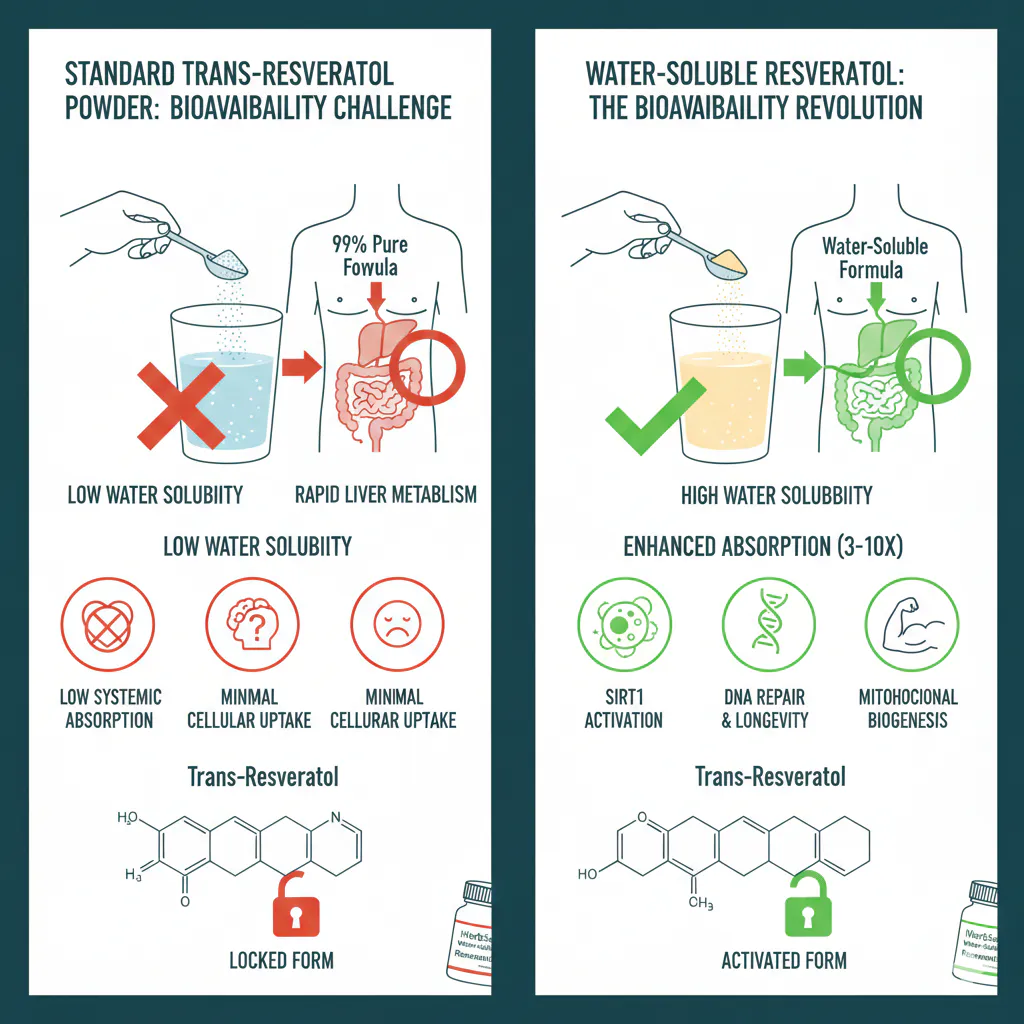
Traditional Standard Resveratrol Powder, typically extracted to 98% or 99% Trans-Resveratrol via HPLC, is a lipophilic (fat-loving) molecule.
The BCS Class II Dilemma
In the Biopharmaceutics Classification System (BCS), Resveratrol is categorized as a Class II compound. This means it has high membrane permeability but extremely low water solubility.
- The Reality: When you consume standard powder, less than 1% of the free form reaches the systemic circulation.
- Rapid Metabolism: What little is absorbed is immediately processed by the liver and intestines into glucuronides and sulfates, rendering the “pure” molecule inactive.
2. What is Water-Soluble Resveratrol?
Water-Soluble Resveratrol is not a different molecule; rather, it is Resveratrol that has undergone molecular engineering or physical encapsulation to overcome its hydrophobic nature.
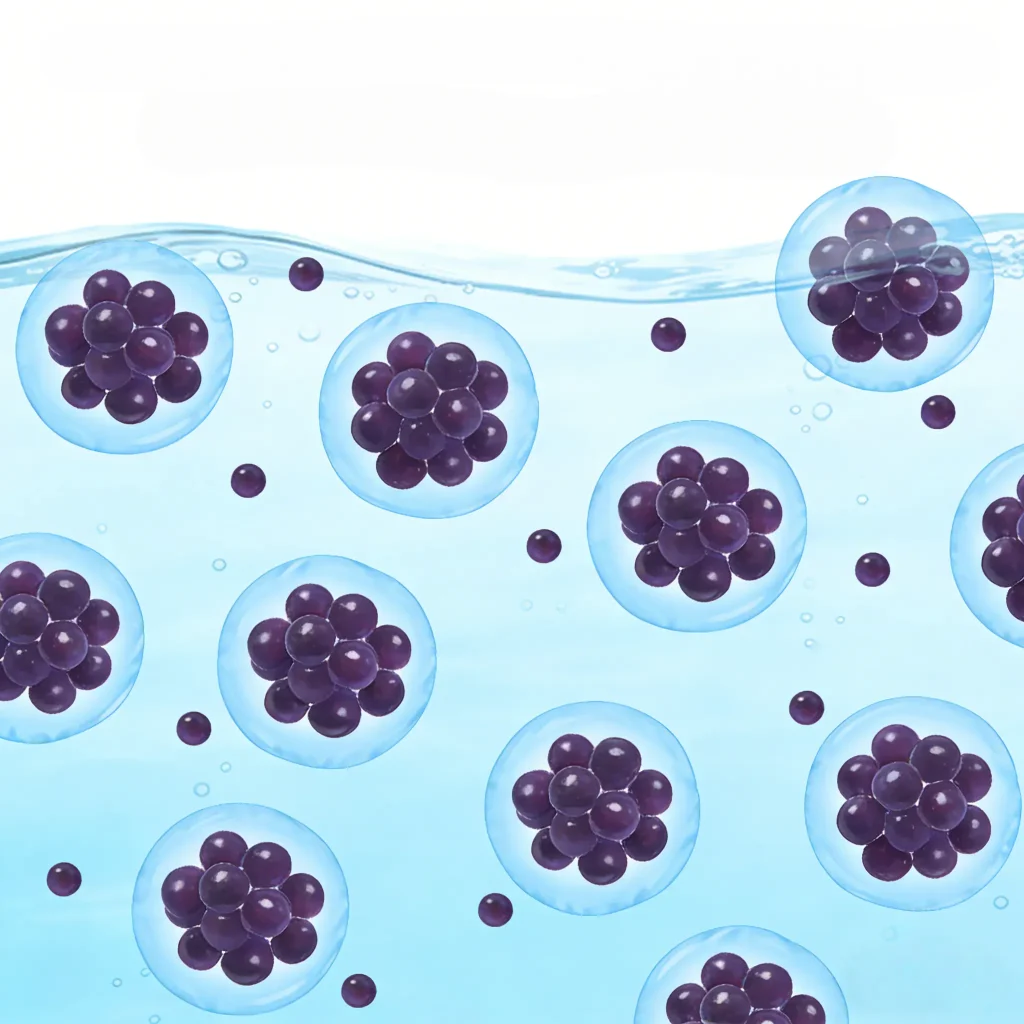
Primary Methods of Creating Water Solubility:
- Micro-encapsulation: Enclosing the Resveratrol in a hydrophilic shell (like maltodextrin or proteins).
- Micellar Delivery: Using surfactants to create “micelles” that mimic the body’s natural fat-digestion process.
- Cyclodextrin Complexation: Trapping the Resveratrol molecule inside a ring of sugar molecules (Cyclodextrin). This creates a “Trojan Horse” effect, where the exterior is water-friendly, but the core carries the potent polyphenol.
- Nano-Emulsification: Reducing particle size to the nanometer scale to increase surface area dramatically.
3. Side-by-Side Comparison: Water-Soluble vs. Standard Powder
| Feature | Standard Resveratrol Powder | Water-Soluble Resveratrol |
| Solubility in Water | < 0.03 mg/mL (Practically Insoluble) | High (> 5-10 mg/mL) |
| Bioavailability | Very Low (High First-Pass Metabolism) | 3x to 10x Higher |
| Ease of Formulation | Hard (Requires fats/oils) | Easy (Ideal for drinks/shots) |
| Gastrointestinal Stress | Can cause upset in high doses | Generally gentler due to lower required dose |
| Purity (HPLC) | Up to 99% | Varies based on the carrier used |
4. The Science of Absorption: The AMPK–Sirtuin–NAD⁺ Pathway
Resveratrol enhances SIRT1 signaling through multiple mechanisms:
●Increasing intracellular NAD⁺ levels: Resveratrol can stimulate enzymes involved in NAD⁺ biosynthesis, such as nicotinamide mononucleotide adenylyltransferase (NMNAT), which increases cellular NAD⁺ availability and subsequently enhances SIRT1 activity.
●Activating AMPK: Resveratrol induces mild cellular energy stress, which activates AMPK and raises the cellular NAD⁺/NADH ratio, further promoting SIRT1 activation.
●Creating a positive feedback loop: AMPK activation stimulates NAD⁺ production, which further enhances SIRT1 activity—forming a self-reinforcing AMPK–NAD⁺–SIRT1 metabolic network associated with improved metabolic efficiency and longevity signaling.
Through this pathway, resveratrol effectively supports NAD⁺ metabolism while simultaneously activating the enzymes that depend on NAD⁺, positioning it as a central regulator of cellular energy and aging pathways.
Mitochondrial Biogenesis
Once activated, SIRT1 regulates downstream transcription factors such as PGC-1α, which promote mitochondrial biogenesis. This leads to the formation of new mitochondria and improved oxidative metabolism, ultimately enhancing cellular ATP production and metabolic efficiency.
Water-soluble or highly bioavailable forms of resveratrol may facilitate more efficient delivery to tissues, helping trigger mitochondrial renewal and supporting sustained cellular energy production.
Autophagy and Cellular Renewal
The AMPK–SIRT1 pathway also inhibits mTOR signaling and activates autophagy—the body’s cellular recycling system. Through this mechanism, damaged proteins and dysfunctional mitochondria are removed, supporting cellular rejuvenation and metabolic resilience.
A Key Nutritional Strategy for NAD⁺ Longevity Pathways
Because SIRT1 activity depends on NAD⁺ availability, compounds that both increase NAD⁺ levels and activate SIRT1—such as resveratrol—play a strategic role in modern anti-aging and metabolic health formulations.
This dual action supports:
●Improved mitochondrial function;
●Enhanced metabolic flexibility;
●Increased resistance to oxidative and inflammatory stress;
●Activation of longevity-associated cellular repair pathways;
Industry Note
For those seeking the highest purity raw material, our Polygonum cuspidatum extract (98% HPLC resveratrol) provides an ideal base ingredient for both standard supplementation and advanced longevity formulations designed to support the AMPK–NAD⁺–SIRT1 pathway.
5. Applications in Skincare: A Game Changer
In the cosmetic industry, the Water-Soluble Resveratrol vs. Standard Powder debate is even more critical.
- Standard Powder: Gritty, hard to stabilize, and often causes discoloration in creams.
- Water-Soluble Form: Allows for the creation of clear serums and fast-absorbing lotions. It penetrates the stratum corneum (the skin barrier) much more efficiently, providing superior antioxidant protection against UV-induced damage
6. Manufacturing Challenges and HPLC Testing
Producing a stable Water-Soluble Resveratrol is significantly more expensive than standard extraction.
- Stability Testing: Resveratrol is highly sensitive to light and oxygen. The encapsulation must protect the molecule from oxidation.
- HPLC Verification: Testing water-soluble versions requires specialized chromatography to separate the carrier from the active Trans-Resveratrol.
At iHerbSea, we ensure that our Non-GMO Resveratrol sources meet strict international standards, whether you are buying bulk 98% powder or looking for custom soluble solutions.
7. How to Choose: Which One is Right for You?
- Choose Standard Powder if: You are budget-conscious and always take your supplements with a high-fat meal (like eggs or avocado), which naturally aids in the absorption of lipophilic compounds.
- Choose Water-Soluble if: You prefer “empty stomach” dosing, utilize liquid delivery systems (wellness shots), or are a manufacturer looking to create a premium, fast-acting product.
8. Synergistic Stacks: Maximizing Resveratrol
Whether soluble or standard, Resveratrol works best when “stacked” with other metabolic activators:
- Berberine HCl: For dual AMPK activation.
- Quercetin: Inhibits the enzymes that break down Resveratrol, keeping it in your blood longer.
- NMN: Provides the “fuel” (NAD+) that Sirtuins need to function.
9. Conclusion: The Bioavailability Revolution
The future of the supplement industry lies in delivery technology. While Standard Resveratrol Powder will always have a place in the market due to its high purity and low cost, Water-Soluble Resveratrol represents the evolution of the molecule. By solving the solubility puzzle, we unlock the true clinical potential of this ancient extract from Polygonum Cuspidatum.
References & Technical Bibliography
- Walle, T., et al. (2004). “High absorption but very low bioavailability of oral resveratrol in humans.” Drug Metabolism and Disposition. View Source
- Amri, A., et al. (2012). “Administration of resveratrol: What formulation solutions to bioavailability limitations?” Journal of Controlled Release.
- David Sinclair, Ph.D. (2019). Lifespan: Why We Age—and Why We Don’t Have To. (Discussing the activation of Sirtuins via Resveratrol).
- Kushner, A., et al. (2021). “Nano-encapsulation of Resveratrol: A Review of Enhanced Solubility and Bioactivity.” International Journal of Nanomedicine.
- Baur, J. A., & Sinclair, D. A. (2006). “Therapeutic potential of resveratrol: the in vivo evidence.” Nature Reviews Drug Discovery.