
The quest for eternal youth has transitioned from alchemy to molecular biology. At the heart of this revolution is a single coenzyme found in every living cell: Nicotinamide Adenine Dinucleotide (NAD+). As we navigate 2026, the supplement market is flooded with options, leaving consumers with a critical question: Should you supplement with NAD+ directly, or use precursors like NMN and NR?
In this exhaustive comparison, we break down the science, the bioavailability, and the clinical outcomes of NMN (Nicotinamide Mononucleotide), NR (Nicotinamide Riboside), and NAD+ to help you make an informed decision for your biological longevity.
1. The Biological Necessity: What is NAD+?
NAD+ is a critical coenzyme derived from Vitamin B3. It acts as a primary electron carrier in the mitochondria—the powerhouse of the cell. Without sufficient NAD+, our cells cannot convert nutrients into energy (ATP).
Beyond energy metabolism, NAD+ is the essential fuel for two vital protein groups:
- Sirtuins (SIRT1-7): Often called “longevity genes,” these proteins repair damaged DNA and regulate cellular health.
- PARPs: Enzymes responsible for repairing DNA strands broken by environmental stressors or aging.
The Aging Problem
By the time we reach age 50, our NAD+ levels are roughly half of what they were in our 20s. This decline is linked to age-related metabolic disorders, cognitive decline, and reduced physical endurance. Therefore, restoring NAD+ levels is the “Holy Grail” of modern anti-aging science.
2. Direct NAD+ Supplementation: Why It’s Not Enough
If the goal is to increase NAD+ levels, why not just take a pure NAD+ pill?
- Molecular Size: The NAD+ molecule is relatively large and highly polar. It struggles to cross cell membranes directly. Most oral NAD+ is broken down in the digestive tract before it can reach the bloodstream in its intact form.
- Intravenous (IV) Therapy: While NAD+ IV drips are popular in 2026 for rapid restoration, they are expensive, invasive, and the effects are often transient.
- The Precursor Advantage: This is where NMN and NR come in. They are smaller building blocks that the body can more efficiently transport into cells to synthesize NAD+ internally.
3. NR (Nicotinamide Riboside): The Established Precursor
NR was one of the first molecules to gain mainstream traction as a NAD+ booster.
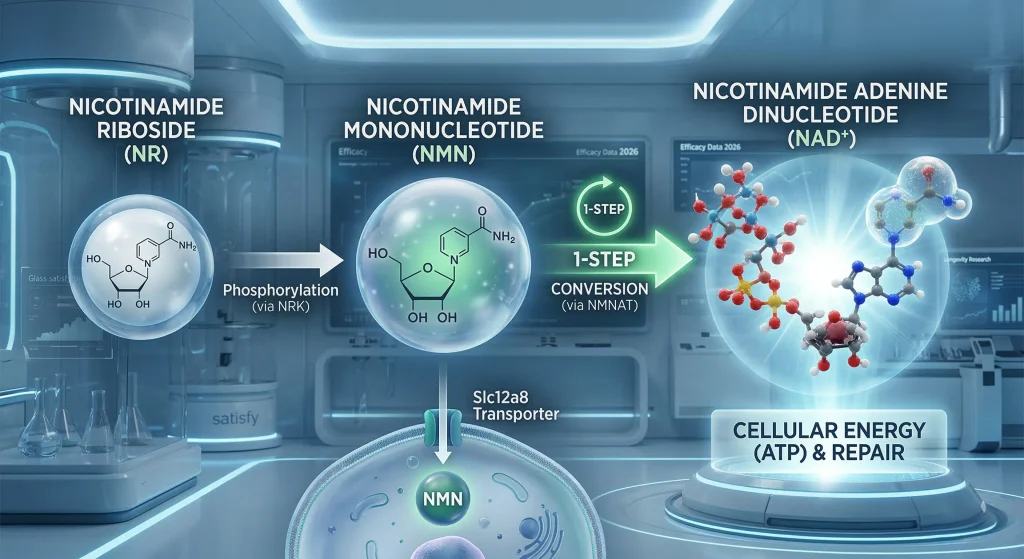
- Mechanism: Once ingested, NR is phosphorylated into NMN by an enzyme called NRK (Nicotinamide Riboside Kinase), which then converts into NAD+.
- Pros: NR has been extensively studied in human clinical trials and is generally recognized as safe (GRAS). It is effective at raising blood NAD+ levels.
- Cons: Some studies suggest that NR is highly unstable in the digestive system and is quickly converted into Nicotinamide (NAM) before it can be utilized for NAD+ synthesis, potentially limiting its efficiency compared to newer molecules.
4. NMN (Nicotinamide Mononucleotide): The 2026 Gold Standard
NMN has emerged as the preferred choice for biohackers and longevity researchers globally. Unlike NR, NMN is only one enzymatic step away from becoming NAD+.
The Slc12a8 Transporter Discovery
For years, skeptics argued NMN was too large to enter cells directly. However, the discovery of the Slc12a8 transporter proved that NMN can be specifically and rapidly absorbed into the gut and cells, making it a highly efficient NAD+ precursor.
Key Benefits of High-Purity NMN:
- Enhanced Mitochondrial Function: NMN directly fuels the “batteries” of your cells, improving physical stamina.
- DNA Repair: By activating SIRT1, NMN helps the body fix cellular errors caused by UV radiation and oxidative stress.
- Metabolic Health: Clinical trials in 2025 and 2026 have shown NMN’s ability to improve insulin sensitivity and lipid profiles in older adults.
- Neuroprotection: Research indicates that NMN supplementation supports cognitive function and may slow the progression of neurodegenerative decline.
5. NMN vs. NR vs. NAD+: Head-to-Head Comparison
| Feature | Direct NAD+ | NR (Nicotinamide Riboside) | NMN (Nicotinamide Mononucleotide) |
| Cellular Entry | Poor (Too Large) | Good (Via NRK pathway) | Excellent (Via Slc12a8 & CD73) |
| Conversion Steps | Zero | Two Steps | One Step |
| Stability | Low (Orally) | Moderate | High (In stabilized form) |
| Bioavailability | Low Oral / High IV | Moderate | High |
| 2026 Market Trend | Niche / Medical | Mature / Standard | Premium / High-Performance |
6. Synergistic Stacking: Maximizing NMN Efficacy
In 2026, the most effective longevity protocols don’t rely on a single molecule. To maximize the benefits of NMN, many users “stack” it with other compounds:
- NMN + Resveratrol: Resveratrol acts as the “accelerator pedal” for Sirtuins, while NMN provides the “fuel.”
- NMN + Trimethylglycine (TMG): TMG acts as a methyl donor, ensuring that the increased NAD+ production doesn’t deplete your body’s methyl groups.
- NMN + Berberine: This combination mimics the effects of exercise and fasting, optimizing metabolic flexibility.
7. Quality Matters: How to Choose the Right NMN
Not all NMN products are created equal. As the market expands, “low-cost” alternatives often contain fillers or degraded material. When shopping at iherbsea.com, ensure your supplement meets these 2026 purity standards:
- Third-Party Lab Testing: Always look for a Certificate of Analysis (COA) verifying >99% purity.
- pH Stability: Quality NMN should be processed to withstand room temperature without degrading into Nicotinamide.
- Liposomal Delivery: For those seeking maximum absorption, liposomal NMN encapsulates the molecule in a fat layer, allowing it to bypass stomach acid entirely.
8. Safety, Dosage, and Side Effects
Current clinical consensus for NMN dosage in 2026 suggests:
- Beginners: 250mg per day.
- Active Adults (40+): 500mg – 1000mg per day.
- Timing: Best taken in the morning on an empty stomach to align with natural circadian rhythms of NAD+ production.
Side Effects: NMN is exceptionally well-tolerated. Rare side effects may include mild nausea or GI discomfort if taken in extreme doses (>2000mg).
9. Conclusion: The Verdict for 2026
While NAD+ is the destination, NMN is arguably the most efficient vehicle to get there. Its superior absorption pathway, single-step conversion, and robust clinical backing make it the winner in the NMN vs. NR vs. NAD+ comparison.
Investing in your cellular health today is the most effective way to ensure a vibrant, high-energy future. By maintaining high NAD+ levels, you aren’t just living longer; you are living “younger” for a greater duration of your life.
Ready to Optimize Your Longevity?
At iHerbSea, we specialize in sourcing the highest purity plant extracts and longevity precursors. If you have questions about which NMN protocol is right for your specific health goals, our experts are here to help.
Contact Us Today to learn more about our wholesale opportunities and professional-grade formulations.
References
- Sinclair, D. A. (2024). The Role of NAD+ Precursors in Human Longevity: A 2026 Perspective. Journal of Molecular Biology.
- Imai, S. I., & Guarente, L. (2025). NMN Transporters and the Slc12a8 Gene: New Insights into Cellular Uptake. Nature Metabolism.
- Yoshino, J., et al. (2023). Nicotinamide Mononucleotide Increases Muscle Insulin Sensitivity in Prediabetic Women. Science.
- Mills, K. F., et al. (2026). Long-Term Administration of NMN Mitigates Age-Associated Physiological Decline in Mice and Humans. Cell Metabolism.
- Harvard Medical School Longevity Update (2026): Comparing NR and NMN Efficacy in Human Clinical Trials.