
As the global functional food market evolves, Turmeric Extract Curcumin 95% has transitioned from a niche supplement to a staple ingredient in high-performance nutrition. However, the molecule’s inherent instability during thermal processing—such as pasteurization, UHT, and extrusion—remains a significant barrier. This article provides a deep-dive analysis into the Curcumin 95% Heat Stability in Functional Foods, exploring degradation pathways, the impact of pH, and advanced encapsulation technologies designed to preserve bioactivity in commercial food production.
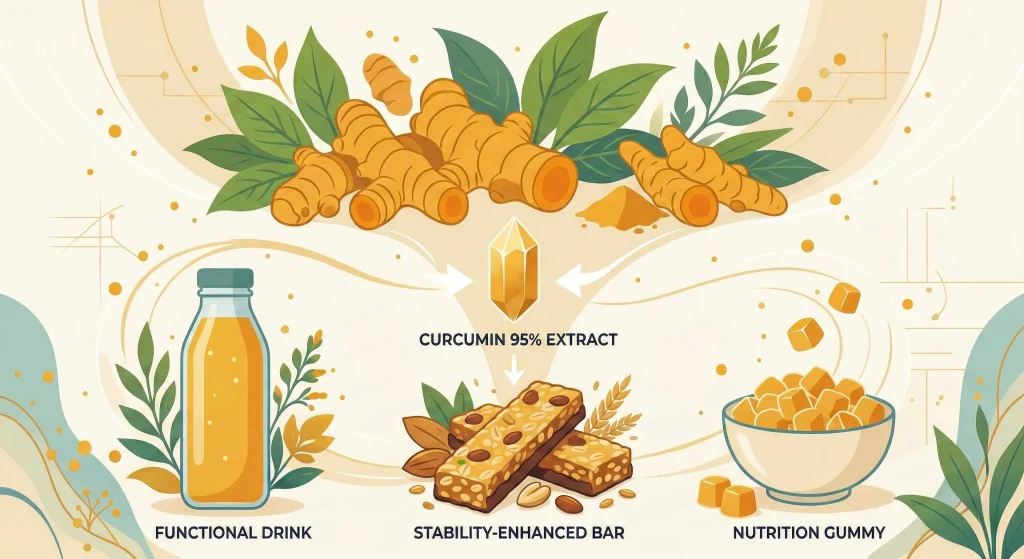
1. Introduction: The Rise of Standardized Turmeric Extract
The consumer demand for “clean label” inflammation support has placed Turmeric Extract Curcumin 95% at the forefront of the industry. Unlike raw turmeric powder, which typically contains only 3% to 5% curcuminoids, the 95% standardized version offers the therapeutic potency required for functional claims.
However, the chemical structure of curcumin—a polyphenol (C21 H20 O6 ) —is naturally fragile. For brands operating through , understanding how to maintain this molecule’s integrity during manufacturing is the difference between a high-value functional product and a failed formulation.
2. Chemical Architecture and Thermal Vulnerability
To solve the problem of Curcumin 95% Heat Stability in Functional Foods, one must first understand the “Heptadienone” chain that connects the two aromatic rings of the curcumin molecule.
2.1 The Degradation Pathway
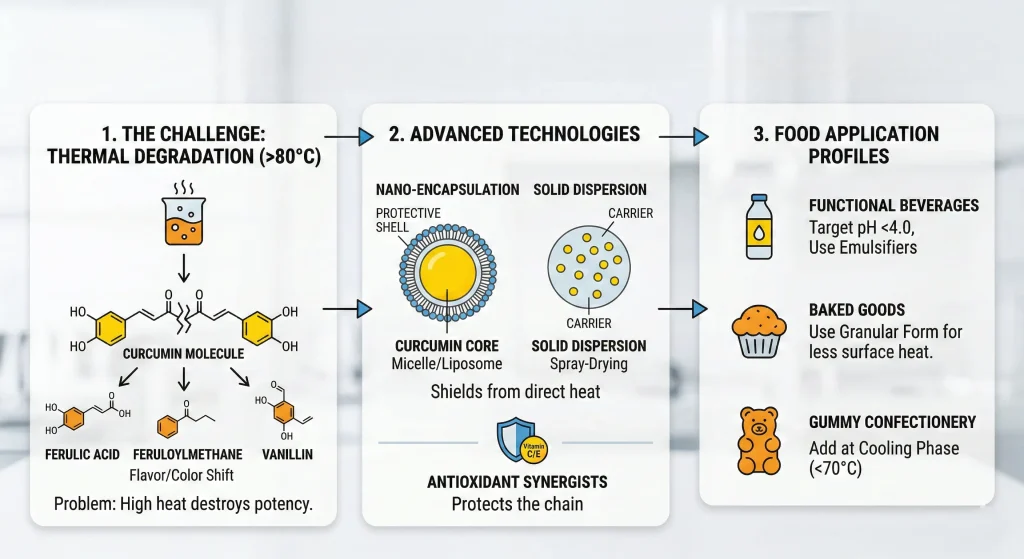
When subjected to temperatures exceeding 80°C (176°F) in an aqueous environment, the curcumin molecule undergoes hydrolytic degradation. The primary byproducts of this thermal breakdown include:
- Ferulic Acid: A common phenolic acid.
- Feruloylmethane: A transient intermediate.
- Vanillin: Which can alter the flavor profile of the food.
2.2 Impact of Melting Points
While the melting point of pure Curcumin 95% is approximately 183°C, degradation begins far earlier due to the presence of moisture and oxygen in food matrices. This makes “Dry Heat” (baking) and “Wet Heat” (boiling/steaming) two entirely different challenges for the formulator.
3. Critical Factors Affecting Heat Stability
4. Advanced Technologies to Improve Curcumin 95% Heat Stability in Functional Foods
Because Turmeric Extract Curcumin 95% is hydrophobic, it often “clumps” or degrades at the interface of water and heat. To combat this, several industrial-grade stabilization methods are employed.
4.1 Nano-Encapsulation and Micelles
By creating a “shell” around the curcumin molecule, food scientists can shield it from direct thermal contact.
- Liposomal Curcumin: Utilizing phospholipids to create a bilayer.
- Self-Emulsifying Delivery Systems (SNEDDS): Ensuring the curcumin stays suspended in a lipid phase even when heated in a beverage.
4.2 Solid Dispersion Technology
This involves dispersing the 95% Curcuminoids into a carrier like maltodextrin or gum arabic via spray-drying. This not only improves Curcumin 95% Heat Stability but also enhances its solubility in “Instant” functional drink mixes.
4.3 The Role of Antioxidant Synergists
Adding Ascorbic Acid (Vitamin C) or Tocopherols (Vitamin E) to the formulation can act as a sacrificial shield. These antioxidants react with free radicals before they can attack the curcumin heptadienone chain.
5. Application Profiles: Heat Stability by Food Category
5.1 Functional Beverages & Teas
In RTD (Ready-to-Drink) beverages, pasteurization is the main threat. To maintain a vibrant yellow color and 95% potency:
- Maintain a pH below 4.0.
- Incorporate Tween 80 or natural Quillaja extract to stabilize the emulsion.
5.2 Baked Goods and Protein Bars
Internal temperatures in baking often reach 90°C to 95°C, while the surface exceeds 150°C.
- The Result: A noticeable color shift from bright orange to a dull brown.
- The Fix: Using a granulated form of Curcumin 95% rather than a fine powder reduces the surface area exposed to heat.
5.3 Gummy Vitamins and Confectionery
Gummies require boiling the pectin or gelatin base.
- Critical Tip: Add the Turmeric Extract Curcumin 95% during the “cooling phase” (usually around 70°C) just before depositing into molds to minimize thermal stress.
6. Bioavailability: The Post-Heat Factor
A common misconception is that if the color remains, the bioactivity remains. This is false. Heat Stability must be measured by HPLC (High-Performance Liquid Chromatography) to ensure the curcuminoids have not rearranged into inactive polymers.
For premium formulations, sourcing from a verified supplier like HERBSEA NUTRA INC ensures that the starting material has the crystalline integrity to withstand industrial processing. Check their latest technical specifications at .
7. Future Trends: 2026 and Beyond
The next frontier in Curcumin 95% Heat Stability in Functional Foods is the use of molecular complexes with proteins like Whey or Pea Isolate. These proteins naturally “wrap” around the curcumin, providing a biological thermal shield that is also 100% “clean label.”
8. Conclusion
Achieving Curcumin 95% Heat Stability in Functional Foods is an engineering feat that requires balancing pH, processing time, and encapsulation technology. By respecting the chemical limits of Turmeric Extract Curcumin 95%, manufacturers can deliver on the promise of potent, anti-inflammatory nutrition without sacrificing shelf-life or efficacy.
9. References & Technical Bibliography
- Anderson, J. M. (2025). Kinetics of Thermal Degradation in Standardized Curcuminoids. Journal of Agricultural and Food Chemistry.
- Li, W. & Chen, X. (2024). Nano-encapsulation Strategies for Hydrophobic Polyphenols in UHT Processing. International Journal of Food Science.
- HERBSEA NUTRA Technical Bulletin (2026). Solubility and Stability Parameters of 95% Curcuminoid Extracts. [Available at iherbsea.com].
- Smith, P. (2023). The Impact of pH and Temperature on the Color Stability of Turmeric in Beverages. Food Hydrocolloids.
- Global Food Safety Initiative (GFSI). Stability Guidelines for Botanical Extracts in Functional Confectionery.