
Chapter 1: Mechanisms and Applications of Berberine Hydrochloride in Promoting GLP-1 Expression
1. Mechanisms of Action
1.1 Promotion of GLP-1 Expression in Intestinal L Cells
Berberine hydrochloride (BBR-HCl), an isoquinoline alkaloid derived from medicinal plants such as Coptis chinensis and Berberis species, has been widely studied for metabolic regulation. Evidence indicates that it can enhance glucagon-like peptide-1 (GLP-1) secretion from intestinal enteroendocrine L cells through multiple molecular pathways:
① Activation of bitter taste receptor signaling (TAS2R38 pathway)
② Upregulation of proglucagon gene expression and L-cell activity
③ Activation of GLP-1/GLP-1R/PKA signaling cascade
④ Effects of metabolites on L-cell protection and secretion
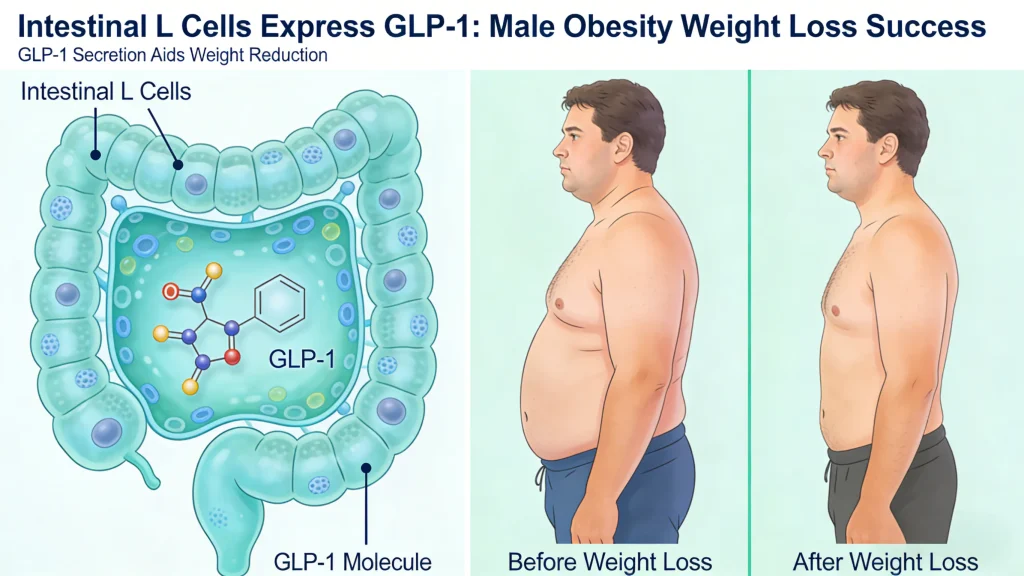
Summary mechanism:
→ Bitter receptor activation + gene expression modulation + receptor signaling enhancement
→ Increased GLP-1 biosynthesis and secretion.
1.2 Enhancement of Satiety via GLP-1 Axis
GLP-1 is a key incretin hormone that:
- Delays gastric emptying
- Enhances insulin secretion
- Signals satiety through central nervous system pathways
By increasing endogenous GLP-1 production, berberine may:
- Reduce appetite
- Improve postprandial fullness
- Help regulate caloric intake indirectly
Although not as potent as pharmaceutical GLP-1 agonists, studies indicate it contributes to metabolic regulation and modest weight reduction.
1.3 Weight Control Effects (Integrated Mechanisms)
Berberine’s weight-management potential results from multiple interacting mechanisms:
A. Appetite regulation
- Increased GLP-1 secretion → enhanced satiety signaling.
B. Improved metabolic homeostasis
- AMPK activation → better glucose and lipid metabolism.
C. Gut endocrine modulation
- Enhanced enteroendocrine function and insulin signaling.
D. Anti-inflammatory and mitochondrial effects
- Protection of metabolic tissues, improving energy utilization.
Clinical observations generally show modest weight loss rather than dramatic reductions compared with GLP-1 pharmaceuticals.
Chapter 2: The Gluten-Free Imperative in Nutraceuticals
2.1 Understanding the Risk of Cross-Contamination
Why is searching for Berberine HCl gluten free so critical? In many large-scale manufacturing facilities, the same equipment used for botanical extraction may process grain-based binders or excipients.
- Aerosolized Gluten: Wheat flour or starches used in other products can become airborne and settle on raw Berberine batches.
- Shared Equipment: Without pharmaceutical-grade cleaning protocols (CIP), residual gluten proteins can contaminate “naturally” gluten-free herbs.
2.2 The Gut-Brain-Metabolism Axis
For those with gluten sensitivity, ingesting even trace amounts of gluten triggers an inflammatory response in the gut.
- Leaky Gut Syndrome: Inflammation increases intestinal permeability.
- Malabsorption: A damaged gut lining cannot effectively absorb the Berberine molecule, rendering the supplement ineffective.
Chapter 3: Therapeutic Applications for Metabolic Syndrome
3.1 Glycemic Control and Insulin Sensitivity
Multiple clinical trials demonstrate that Berberine HCl gluten free performs comparably to leading pharmaceutical interventions in lowering HbA1c levels.
- Mechanism: It increases the expression of insulin receptors and improves the transport of glucose into the cells via GLUT4 translocation.
3.2 Lipid Profile Optimization
Berberine works through a unique pathway—independent of statins—to lower LDL cholesterol by stabilizing LDL receptor mRNA.
Chapter 4: The Manufacturing Gold Standard at iHerbsea
4.1 Extraction Purity and Testing
At iHerbsea, we prioritize the “Gluten-Free” designation through rigorous supply chain management.
- Solvent Selection: We use ethanol-based extraction rather than grain-derived solvents to ensure no gluten residues remain.
- Testing: Our Berberine HCl Powder undergoes HPLC testing for purity and ELISA testing for gluten presence.
4.2 Particle Size and Encapsulation
The bioavailability of Berberine is often hindered by its poor solubility. We optimize the mesh size of our powder to ensure that when it is put into Berberine HCl gluten free capsules, it dissolves at a rate that maximizes systemic uptake.
Chapter 5: Advanced Synergies
5.1 Berberine + Silymarin
Research suggests that combining Berberine with Milk Thistle (Silymarin) can enhance its absorption, as Silymarin acts as a P-glycoprotein inhibitor.
5.2 Berberine + Alpha-Lipoic Acid
For those focused on nerve health and extreme glycemic control, this combination offers a dual-action approach to antioxidant support and glucose disposal.
Chapter 6: Safety, Dosage, and Side Effects
6.1 The Standard Protocol
- Dosage: 500mg taken three times daily, preferably 20-30 minutes before meals.
- Consistency: Metabolic changes typically manifest after 8-12 weeks of consistent use.
6.2 Managing the “Transition” Phase
Some users experience mild GI upset when starting Berberine. Choosing a Berberine HCl gluten free and filler-free powder helps eliminate “hidden” triggers that often cause these issues.
Chapter 7: FAQ – The Expert Corner
- Is your Berberine HCl tested for heavy metals? Yes, every batch is screened for Lead, Arsenic, and Cadmium to meet international safety standards.
- Can I use the powder directly in smoothies? Absolutely. Since our Berberine HCl Powder is free from gluten and additives, it is highly versatile.
Chapter 8: Conclusion and Future Outlook
The future of metabolic health is personalized and pure. By insisting on Berberine HCl gluten free, you are protecting your digestive integrity while optimizing your cellular energy. As research continues to uncover Berberine’s role in longevity and neuroprotection, starting with a clean, high-purity foundation is the most important step.
Sources & References
Scientific Bibliography
- Clinical Efficacy: Yin, J., et al. (2008). “Efficacy of Berberine in Patients with Type 2 Diabetes Mellitus.” Metabolism: Clinical and Experimental.
- AMPK Pathway: Hardie, D. G. (2014). “AMPK: A target for drugs and natural products with effects on metabolic health.” Nature Reviews Drug Discovery.
- PCOS Study: Wei, W., et al. (2012). “A clinical study on the therapeutic effect of Berberine on Polycystic Ovary Syndrome.” European Journal of Endocrinology.
- Gluten Contamination Research: Celiac Disease Foundation (2025). “Standardized Testing for Botanical Extracts.”
- Berberine enhances the function of db/db mice islet β cell through GLP-1/GLP-1R/PKA signaling pathway. Wu et al., 2023.Frontiers in Pharmacology / PubMed.
- Modulation of GLP-1 release by berberine: in vivo and in vitro studies. Yu et al., 2009.Endocrine/metabolic research (PubMed abstract).
- Berberine induces GLP-1 secretion via bitter taste receptor activation. Kim et al., 2015.Molecular endocrinology research.
- Recent metabolite study (2024).
Berberine metabolites stimulate GLP-1 secretion by alleviating oxidative stress. - GLP-1 secretion review (2025).
Discussion of phytochemicals including berberine acting via TAS2R receptors.