
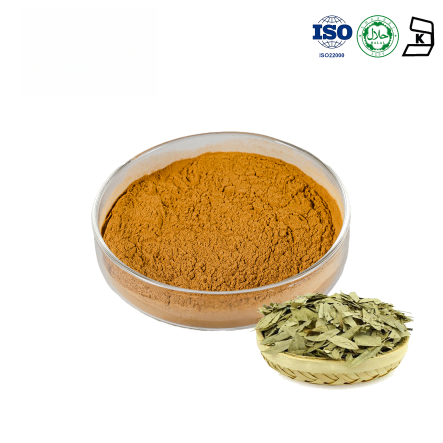
Introduction Of Senna Leaf Extarct
Senna is a shrub that grows to about two feet tall with green stems, pods and yellow spade-shaped leaves. Its alternate leaves are evergreen with four to five pairs of lanceolate or obovate gray-green fragile leaflets. The leaves and pods or fruit are used medicinally.
Senna narrowleaf leaf extract is derived from the leaves. The leaves of Senna narrowleaf contain sennoside C, a rhubarbic acid-rutinoside-dianthrone-8,8′-diglucoside. The pods contain, in addition to sennosides A and B, glucosides of rhubarbic acid and rhubarbol, and traces of ruthene rhubarbol or rhubarbol glucoside. The leaves and pods of Senna acuminata contain 0.85-2.86% and 2.34-3.16% of anthracene constituents, respectively, from which rhubarbic acid, ruthene rhubarbol, a small amount of rhubarb phenol, and senna glucosides such as senna glucosides A, B, and C are separated. These anthracene components are present as glycosides. The plant also contains 3,5-dimethyl-4-methoxybenzoic acid. The genus Senna contains tannins, leaves contain sennosides, and the bark contains polyphenol oxidase.
Function Of Senna Leaf Extarct
Senna Leaf Extract was effective against gastric and duodenal bleeding. Immediate hemostasis was seen under direct vision when Senna Leaf Extract was sprayed on gastric bleeding under gastroscopy. Oral administration of Senna Leaf Extract increased platelet count and fibrinogen content, shortened clotting time, prothrombin time, plasma recalcification time and clot contraction time. In addition, the protective effect of senna extract on hydrochloric acid-induced gastric mucosal injury in rats and anti-inflammatory pain were also beneficial in the prevention and treatment of gastric and duodenal bleeding.
Senna Leaf Extract has inhibitory effects on a variety of bacteria, such as Escherichia coli, Proteus mirabilis, Streptococcus dysenteriae, and Streptococcus A, as well as Candida albicans and certain pathogenic skin fungi.


评价
目前还没有评价