
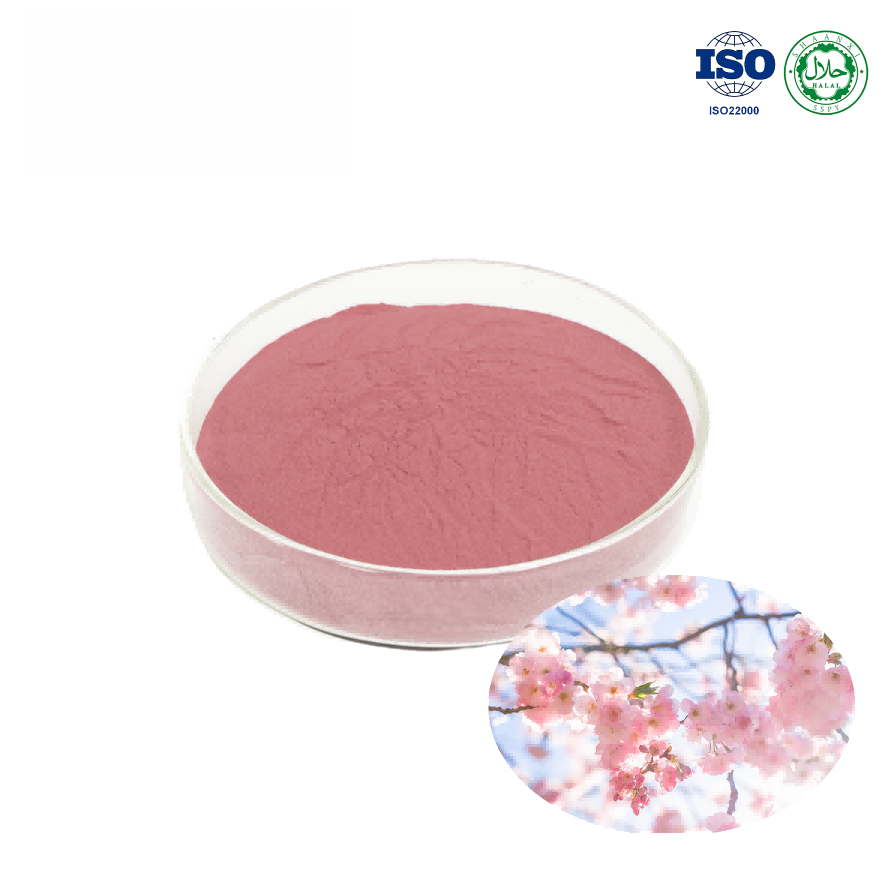
| Sakura Extract | |||
| Product Code | N/A | Specification | 2% 1- O-caffeyl -β -d-glucopyranoside, 0.1% Quercetin -3-O-β -D-glucopyranoside |
| Botanical Source | Prunus Lannesiana | Part Used | Flower |
| Extract Solvent | Ethanol / Water | Assay Method | Enterprise method |
| Character | light pink to reddish brown | Certification | ISO22000, HALAL |
Sakura Extract Product Introduction
Our Sakura Extract is a natural plant extract derived from the flowers of Kwanzan Sakura (a representative species of Yaezakura), retaining the nutritional components and active substances of fresh Kwanzan Sakura. It combines the ornamental value and edible health benefits of sakura, making it suitable for functional foods, beverages, cosmetics, and other application scenarios.
1. Raw Material: Kwanzan Sakura – Origin & Characteristics
1.1 Botanical Identity & Distribution
Kwanzan Sakura (commonly known as “red tassel”) belongs to the Rosaceae family, a deciduous small tree and a classic representative of Yaezakura (double-flowered cherry). It is widely planted in China and has become a well-known ornamental and edible sakura variety.
1.2 Morphological & Edible Traits
- Flower Characteristics: The flowers are bright pink, with a flower stem length of about 6cm, approximately 30 petals, and 2 foliated pistils (which means it cannot bear fruit). The pedicel is thick and long, and the young leaves show a unique tea-brown color.
- Edible History: It has a long consumption history in Japan, South Korea, and Taiwan (China), and is widely used as a vegetable or food ingredient. Both dried and fresh Kwanzan Sakura can be eaten, with diverse eating methods (salting, roasting, steaming, making tea, brewing wine, etc.).
2. Nutritional & Active Components of Sakura
Our Sakura Extract fully retains the rich nutrients and unique active substances of Kwanzan Sakura, with clear ingredient advantages:
- Basic Nutrients: Contains protein, a small amount of fat, sugar, and multiple vitamins—providing basic nutritional support for the body.
- Amino Acids & Trace Elements: Rich in various amino acids (essential for physiological functions) and essential trace elements such as potassium, sodium, magnesium, calcium, and phosphorus.
- Unique Active Substances: Contains specific sakura-derived components (e.g., sakura glycosides), a small amount of corianderine, and steroid compounds—these are the core substances that support the extract’s functional value.
3. Core Advantages of Sakura Extract
- Natural & Safe: Made from edible Kwanzan Sakura flowers, with a long history of safe consumption in multiple regions, no toxic side effects, and high compatibility with food and cosmetic formulas.
- Nutrient Concentration: Compared with direct consumption of fresh or dried sakura, the extract concentrates active ingredients and nutrients, making it easier to absorb and more convenient to apply in product development.
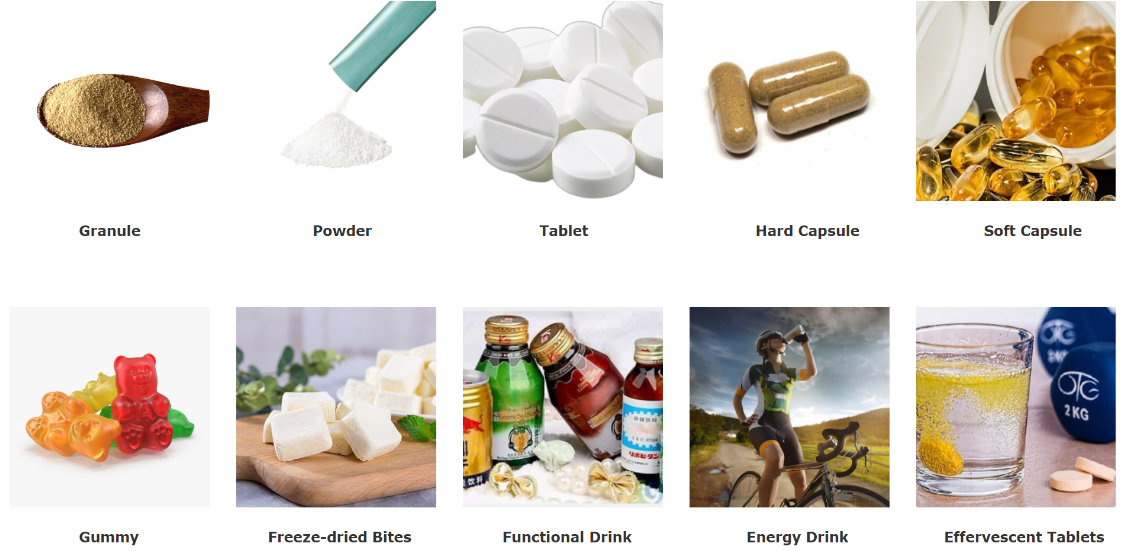
- Multi-Scenario Adaptability: It inherits the fresh flavor and functional properties of sakura, and can be added to beverages (such as sakura-flavored drinks), pastries, health foods, or skin care products (utilizing its nutritional properties for skin care).
Sakura Extract Product Introduction
Our Sakura Extract is a natural plant extract derived from the flowers of Kwanzan Sakura (a representative species of Yaezakura), retaining the nutritional components and active substances of fresh Kwanzan Sakura. It combines the ornamental value and edible health benefits of sakura, making it suitable for functional foods, beverages, cosmetics, and other application scenarios.
1. Raw Material: Kwanzan Sakura – Origin & Characteristics
1.1 Botanical Identity & Distribution
Kwanzan Sakura (commonly known as “red tassel”) belongs to the Rosaceae family, a deciduous small tree and a classic representative of Yaezakura (double-flowered cherry). It is widely planted in China and has become a well-known ornamental and edible sakura variety.
1.2 Morphological & Edible Traits
- Flower Characteristics: The flowers are bright pink, with a flower stem length of about 6cm, approximately 30 petals, and 2 foliated pistils (which means it cannot bear fruit). The pedicel is thick and long, and the young leaves show a unique tea-brown color.
- Edible History: It has a long consumption history in Japan, South Korea, and Taiwan (China), and is widely used as a vegetable or food ingredient. Both dried and fresh Kwanzan Sakura can be eaten, with diverse eating methods (salting, roasting, steaming, making tea, brewing wine, etc.).
2. Nutritional & Active Components of Sakura
Our Sakura Extract fully retains the rich nutrients and unique active substances of Kwanzan Sakura, with clear ingredient advantages:
- Basic Nutrients: Contains protein, a small amount of fat, sugar, and multiple vitamins—providing basic nutritional support for the body.
- Amino Acids & Trace Elements: Rich in various amino acids (essential for physiological functions) and essential trace elements such as potassium, sodium, magnesium, calcium, and phosphorus.
- Unique Active Substances: Contains specific sakura-derived components (e.g., sakura glycosides), a small amount of corianderine, and steroid compounds—these are the core substances that support the extract’s functional value.
3. Core Advantages of Sakura Extract
- Natural & Safe: Made from edible Kwanzan Sakura flowers, with a long history of safe consumption in multiple regions, no toxic side effects, and high compatibility with food and cosmetic formulas.
- Nutrient Concentration: Compared with direct consumption of fresh or dried sakura, the extract concentrates active ingredients and nutrients, making it easier to absorb and more convenient to apply in product development.
- Multi-Scenario Adaptability: It inherits the fresh flavor and functional properties of sakura, and can be added to beverages (such as sakura-flavored drinks), pastries, health foods, or skin care products (utilizing its nutritional properties for skin care).
Process Of Sakura Extract

Applications Of Sakura Extract

评价
目前还没有评价